
Accumulator Bets In Horse Racing: How The Maths Punishes You And When It Pays
 Available in US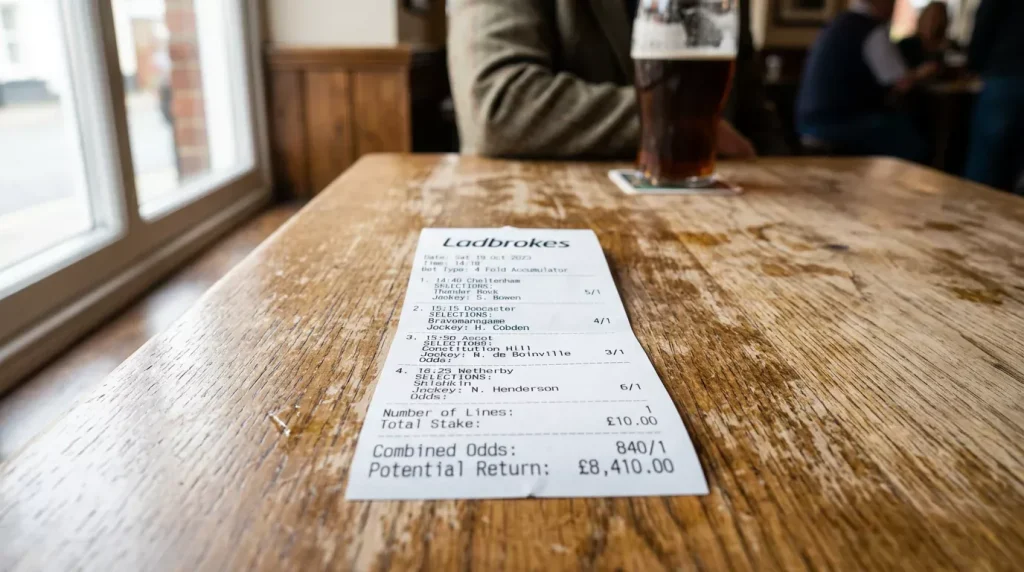
The Saturday Afternoon Fantasy
I placed my first four-fold accumulator on a wet Saturday at Haydock. Four horses, four races, a fiver from my back pocket and a projected return of just over £400. I still remember the third leg winning by a neck and the fourth trailing in sixth. That slip went in the bin, and roughly 96% of all accumulators follow the same path. The promise of turning small change into a windfall is the engine of the accumulator, but it runs on a fuel most punters never bother to measure – compounded probability working squarely against you.
Horse racing accumulators generate a disproportionate share of bookmaker profit relative to their turnover. The Grand National alone sees around £350 million staked annually, and a huge chunk of that flows through multiples where 82% of individual bets are £5 or less. The bookmaker does not need to beat you on every leg; the maths does that job with ruthless efficiency.
Accumulator Bets In Horse Racing — More on this topic at horse racing betting how to .
What An Accumulator Actually Is
An accumulator – acca in everyday shorthand – is a single bet that links two or more selections across different races. The return from the first winner rolls into the second, and so on through every leg. All selections must win for the bet to pay out. A double covers two legs, a treble covers three, and anything beyond that is labelled a four-fold, five-fold, or simply an accumulator.
The appeal is obvious. If you back four horses individually at £5 each, you spend £20 and collect four separate returns. If you roll the same selections into a four-fold at £5, you spend £5 once and the potential return dwarfs what four singles could offer. That gap between the individual return and the combined return is the hook – and the trap.
Bookmakers love accumulators for a reason that has nothing to do with generosity. Every leg you add multiplies not only your potential payout but also the bookmaker’s edge. A single bet against a margin of, say, 5% is one thing. Four legs of 5% compounded is something far uglier for the punter.
How The Odds Multiply – And What That Really Means
Last spring I ran a simple experiment. I picked four horses at Kempton, all priced around 3/1. A £10 single on any one of them returned £40 if it won. A four-fold at £10 returned £2,560. The multiplied odds were 255/1 – thrilling on the slip, brutal in probability.
The calculation is straightforward. Convert each fractional price to decimal: 3/1 becomes 4.0. Multiply the decimals together: 4.0 x 4.0 x 4.0 x 4.0 = 256.0. Multiply by your stake and subtract it to get profit. The number is real, but your chance of collecting it is roughly 1 in 256 in a fair market – and the market is never fair, because every price includes the bookmaker’s overround.
Overround is the silent tax on accumulators. If a bookmaker builds a 10% margin into each leg, the true probability implied by each price is slightly worse than the decimal suggests. Over four legs, that 10% does not add up to 40%. It compounds. By the fourth leg the effective margin on the acca can exceed 45%. You are not betting against the horses; you are betting against geometry.
Total UK betting turnover on horse racing fell 4.3% in 2025 compared with 2024, and 10.3% against 2023, yet acca staking remains sticky. Bookmakers know the psychology: a £5 acca feels disposable, and the projected return feels attainable. Neither instinct is accurate.
The Accumulator Trap
There is a pattern I see every festival season. A punter lands three winners from four, misses the payout by one leg, and concludes they were “unlucky.” They were not unlucky. They were operating exactly within the expected distribution. Three from four in a four-fold means zero return – the same as zero from four. The acca does not reward near-misses. It punishes them identically to total failure.
This asymmetry is the trap. In a single bet, you either win or you lose, and the loss is limited to your stake. In an accumulator, you can be right most of the time and still walk away with nothing. The longer the acca, the worse it gets. A six-fold at 2/1 per leg carries implied odds of 728/1. You would need to land that exact combination once in roughly every 729 attempts just to break even – before margin.
The emotional cost is underestimated, too. Watching three legs come in and then seeing the fourth beaten a length does something to your judgement. It creates an illusion of proximity – a feeling that you are close to cracking accumulators – when in reality the near-miss is baked into the maths at a frequency that keeps you coming back.
See also Lucky 15 To Goliath .
Acca Insurance Offers
Most major bookmakers now offer some form of acca insurance or acca boost. The typical deal: if one leg of your five-fold lets you down, you get your stake back as a free bet. Sounds generous. It is not.
The free bet itself carries restrictions – it usually returns profit only, not the stake, and it expires quickly. More importantly, the insurance encourages longer accumulators, which is precisely where the bookmaker’s compounded edge is fattest. A five-fold with insurance is marginally less painful than a five-fold without it, but it is still a five-fold. The insurance does not change the underlying probability; it softens the psychological blow of the near-miss, which in turn keeps you placing five-folds instead of singles or doubles.
I have spoken with recreational punters who choose their bookmaker primarily based on acca insurance. That is like choosing a restaurant because they refund one course if the chef burns it. The better question is whether you should be ordering five courses at all.
When Accumulators Actually Make Sense
I am not going to pretend accumulators are always irrational. They have a place, but that place is narrow and specific. The honest case for an accumulator rests on three conditions.
First, entertainment staking. If you are going to a festival day, you have set aside £10 for the afternoon, and you want the buzz of following four races with skin in the game, a four-fold at £2.50 is a reasonable use of that budget. You have accepted the stake as gone before the first race. This is the Grand National model, where the vast majority of bets are tiny stakes placed for fun – and where trying to turn a profit is beside the point.
Second, correlated markets. In rare cases, selections are genuinely linked – a yard in exceptional form running multiple horses at the same meeting, or a particular ground condition that suits a batch of confirmed mudlarks. Correlation does not eliminate the maths, but it can reduce the independence assumption that makes accumulators so punishing. These situations are uncommon and require genuine form knowledge, not wishful thinking.
Third, short doubles and trebles. A double on two strong selections at short prices is a different proposition from a six-fold of speculative outsiders. The compounded margin is smaller, the probability of landing both legs is materially higher, and the return is modest enough that you are not chasing a fantasy. If you view doubles and trebles as a way of slightly leveraging conviction rather than manufacturing miracles, the maths is manageable. Anything beyond a treble, for the serious punter, is difficult to justify on expected-value grounds.
For a deeper look at how accumulators fit into the wider landscape of horse racing bet types, that is worth reading before you commit to any multi-leg strategy.
The Honest Arithmetic Of Walking Away
Here is the exercise I recommend to anyone who places regular accumulators. Add up every acca stake you have placed over the past six months. Then add up every acca return you have collected. Divide the return by the stakes. If that number is above 1.0, you are in the minority – a small minority. If it is below 0.5, you are losing more than half your acca budget to the compounded margin, and the entertainment is expensive.
Accumulators are a feature of horse racing betting, not a strategy. They work as an occasional punt with money you can afford to lose entirely. They fail as a system, as a habit, or as a shortcut to profit. The maths is not complicated; it is just uncomfortable. And discomfort, in betting, is usually the most reliable signal that you are looking at the problem clearly.
Articles



Written by the editors at Furlongcraft.
