
How To Read Horse Racing Odds In The UK: Fractions, Probability And Value
 Available in US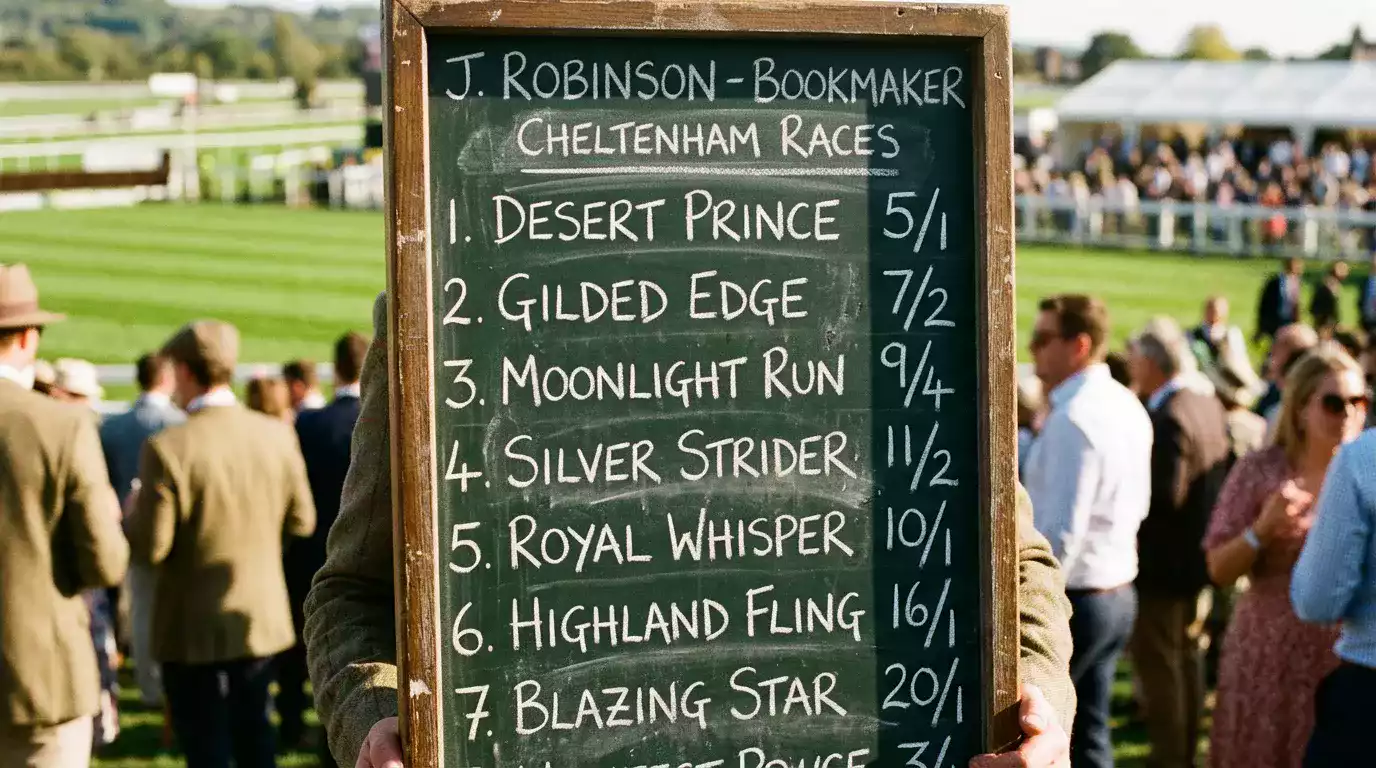
The first time someone told me a horse was "7/2," I reached for a calculator. Two years later I could glance at a racecard and know, without thinking, that 7/2 meant £3.50 profit per pound staked, an implied probability of around 22%, and -- depending on the bookmaker's overround -- either a price worth taking or one built to clip my bankroll slowly. That gap between confusion and fluency is what this guide closes.
British horse racing runs on fractional odds. While most of Europe and the betting exchanges have moved to decimals, the UK racecard, the on-course bookmaker, and the morning show-price still speak in fractions. Understanding them is not optional if you want to bet with any edge at all. Fractional odds are how the market communicates probability, margin, and -- if you learn to listen -- value.
Why British Racing Still Speaks in Fractions
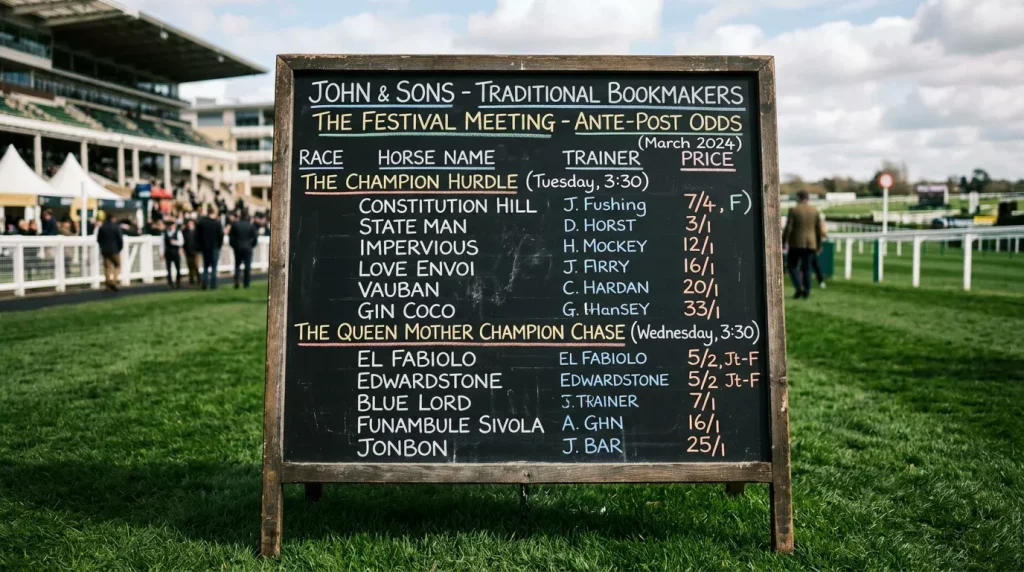
Walk into any racecourse betting ring and the prices are chalked up as fractions: 5/1, 9/4, 11/8. This is not nostalgia -- it is tradition with mechanical roots. Fractional odds were the native language of the Tattersalls ring long before anyone coded a betting app, and the format stuck because it does one thing simply: it tells you exactly how much profit you stand to make for every unit you risk.
The continental alternative -- decimal odds -- bundles stake and profit into a single number. At decimal 4.50, your total return per £1 staked is £4.50, including the pound you put in. The fraction 7/2 says the same thing differently: £7 profit for every £2 staked, or 3.50 per £1. Both formats carry the same information; fractions just separate the profit from the stake visually, which is why the on-course market still prefers them. When a bookmaker shouts "seven to two," everyone in the ring knows instantly what the payout would be.
Betting exchanges -- Betfair, Smarkets, Betdaq -- default to decimals because they serve an international audience and because decimal notation makes it easier to compare prices at small intervals (the difference between 4.40 and 4.50 is a lot clearer than between 17/5 and 7/2). Most online bookmakers let you toggle between formats. But the market still forms in fractions, the Racing Post prints them, and any guide that teaches you decimals without teaching you to read the fraction first is starting in the wrong place.
If you only remember one thing from this section: fractional odds show profit relative to stake. The left number is what you win; the right number is what you risk. Everything else in this article builds from that single idea.
The Fraction, Line by Line
I keep a whiteboard above my desk with the twelve most common racing prices written out. Not because I still need it, but because visitors always ask -- and the question is always the same: "What does the slash mean?" The slash is the key. It separates your profit (left) from your stake (right).
| Fractional | Meaning | £10 Stake Profit | £10 Stake Total Return |
|---|---|---|---|
| 10/1 | £10 profit per £1 staked | £100 | £110 |
| 5/1 | £5 profit per £1 staked | £50 | £60 |
| 7/2 | £7 profit per £2 staked (£3.50 per £1) | £35 | £45 |
| 9/4 | £9 profit per £4 staked (£2.25 per £1) | £22.50 | £32.50 |
| Evens (1/1) | £1 profit per £1 staked | £10 | £20 |
| 4/6 | £4 profit per £6 staked (£0.67 per £1) | £6.67 | £16.67 |
| 1/3 | £1 profit per £3 staked (£0.33 per £1) | £3.33 | £13.33 |
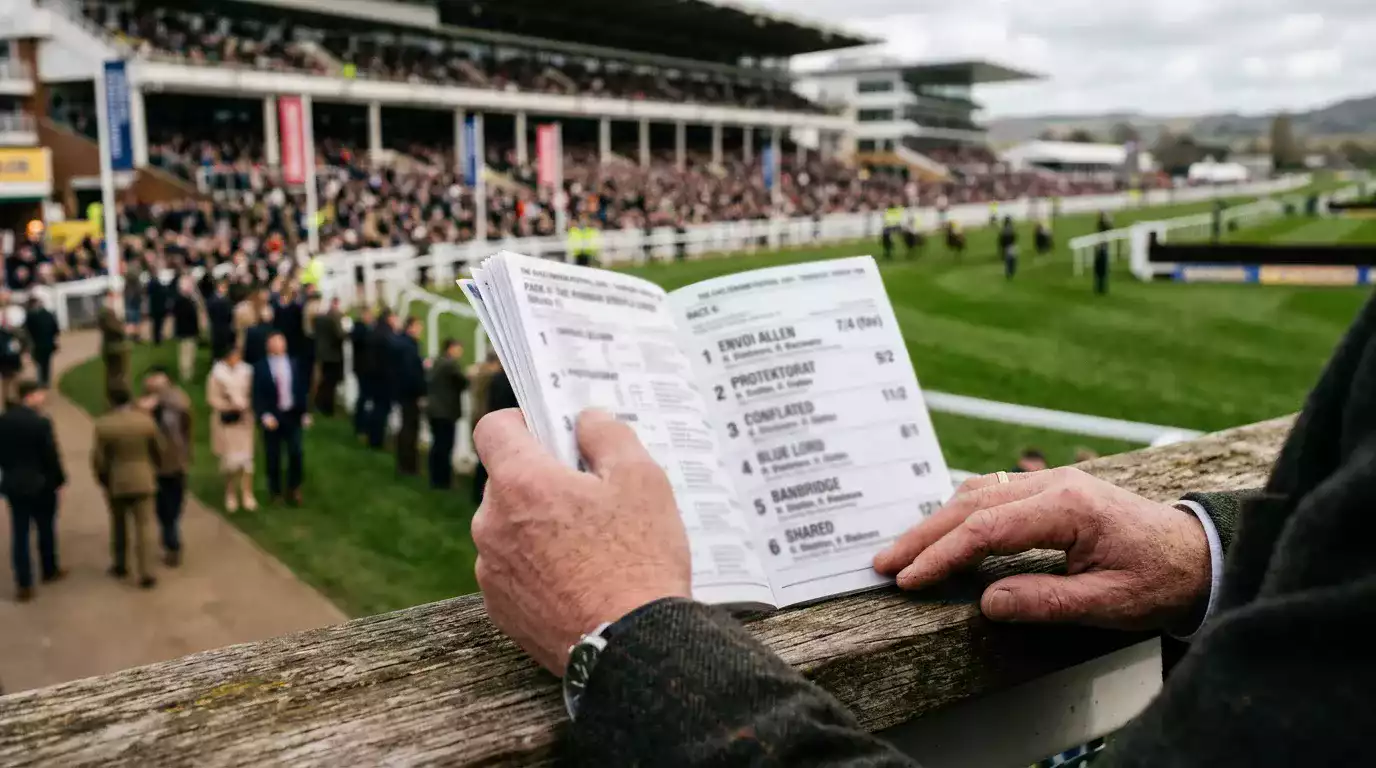
When the left number is larger than the right, the horse is odds-against -- the market thinks it is more likely to lose than to win, so the payout rewards the risk. When the left number is smaller than the right, the horse is odds-on -- favoured to win, but the reward is less than your stake. At evens, the two sides balance: stake and profit are equal.
The formula to turn a fractional odd into a per-pound profit is division: left divided by right. At 9/4, that is 9 / 4 = 2.25. Multiply by your stake to get the profit. A £20 bet at 9/4 returns £45 profit (20 x 2.25) plus the £20 stake, for a total of £65.
Odd prices like 11/8, 13/8, and 15/8 sometimes trip up beginners because they look messy. They work exactly the same way. At 11/8, you win £11 for every £8 staked -- or £1.375 per £1. A £10 bet returns £13.75 profit plus your stake.
There is no mystery to the fraction once the slash clicks: left is profit, right is stake, division gives you the rate. Train yourself on five or six common prices and the rest become intuitive.
Converting Fractions to Decimals and Back Again
I switch between fractional and decimal odds constantly -- fractions when I am reading a racecard or watching a morning show-price, decimals when I am comparing prices across exchanges or running expected-value calculations. The conversion is mechanical, and once you have done it a dozen times, you stop reaching for a calculator.
Fractional to decimal
Divide the left number by the right, then add 1.
5/1 = (5 / 1) + 1 = 6.00
7/2 = (7 / 2) + 1 = 4.50
9/4 = (9 / 4) + 1 = 3.25
4/6 = (4 / 6) + 1 = 1.67
The decimal figure is your total return per £1 staked, including the stake itself.
Decimal to fractional
Subtract 1 from the decimal, then express the result as a fraction in its simplest form.
6.00 - 1 = 5 = 5/1
4.50 - 1 = 3.5 = 7/2
3.25 - 1 = 2.25 = 9/4
1.67 - 1 = 0.67 = approximately 4/6
The +1 in the fractional-to-decimal conversion is not arbitrary. It represents your stake being returned on top of the profit. Decimal odds include the stake; fractional odds show only the profit. That single difference is why the two formats confuse people who try to compare them without converting.
When prices sit at non-standard fractions -- 100/30, for example, which occasionally appears in ante-post markets -- the same formula applies: (100 / 30) + 1 = 4.33. Some bookmakers simplify 100/30 to 10/3, which looks cleaner but gives the same decimal. If you can divide, you can convert.
What the Odds Are Really Telling You About Probability
Every set of odds implies a probability. This is the single most important concept in this article, and the one that separates a punter who reads the market from one who follows it blindly. The odds do not just set your payout -- they tell you what the market thinks about the horse's chance of winning.
The formula is straightforward: divide the stake side of the fraction by the total of both sides, then multiply by 100 to get a percentage.
Implied probability from fractional odds
At 5/1: stake / (profit + stake) = 1 / (5 + 1) = 1/6 = 16.7%
At 7/2: 2 / (7 + 2) = 2/9 = 22.2%
At Evens (1/1): 1 / (1 + 1) = 1/2 = 50.0%
At 1/3: 3 / (1 + 3) = 3/4 = 75.0%
If you prefer decimals, the calculation is even simpler: 1 divided by the decimal odds, multiplied by 100. At decimal 4.50 (which is 7/2), 1 / 4.50 = 0.222, or 22.2%.
Implied probability is not true probability. It is what the odds suggest once you strip out the bookmaker's built-in margin. A horse priced at 5/1 has an implied probability of 16.7%, but the bookmaker has inflated the probabilities across the field to guarantee themselves a profit. The true probability of that horse winning might be 18% or 14% -- and figuring out which is the entire game.

This is where betting stops being a mechanical exercise and becomes an analytical one. If you believe a horse has a genuine 25% chance of winning and it is priced at 7/2 (implied 22.2%), the price is offering you value. If you believe its chance is only 15%, the price is a trap. Every profitable punter I know starts from implied probability and works outward.
The Overround and How Bookmakers Bake In Their Edge
A perfectly fair market would price every runner so that the implied probabilities of all horses in a race added up to exactly 100%. In practice, they never do. The total is always above 100%, and the difference is the bookmaker's overround -- the margin that ensures the book makes money regardless of which horse wins.
Calculating overround
Take a four-runner race with the following prices:
Horse A: 2/1 (implied 33.3%)
Horse B: 3/1 (implied 25.0%)
Horse C: 7/2 (implied 22.2%)
Horse D: 5/1 (implied 16.7%)
Sum of implied probabilities = 33.3 + 25.0 + 22.2 + 16.7 = 97.2%
That would suggest the book is under-round -- offering more value than it should. In reality, the prices would be tighter: Horse A at 15/8 (34.8%), Horse B at 5/2 (28.6%), Horse C at 3/1 (25.0%), Horse D at 9/2 (18.2%). Sum = 106.6%. The overround is 6.6%.
The Horserace Betting Levy Board's chief executive Alan Delmonte has pointed to a tension at the heart of the market: levy income has risen for a fourth consecutive period, yet betting turnover on British racing continues to fall. That wariness, he observed, reflects the risk that current margins may not hold. The overround is the mechanism that generates those margins. When bookmakers widen the overround -- clipping an extra percentage point from each runner's price -- the punter pays more for the same bet. On everyday cards where turnover has been declining, the temptation to widen margins is stronger, and the overround tends to creep upward.
On premier fixtures -- Cheltenham, Royal Ascot, the Grand National -- competition between bookmakers compresses the overround. More operators are chasing the same high-volume market, and the result is tighter prices and better value for the punter. Betting turnover on British racing fell 4.3% in 2025 compared to 2024, and 10.3% against 2023, but the drop was heavily concentrated on core fixtures. On the big days, turnover per race actually grew.
The lower the overround, the more of your money goes towards potential profit rather than bookmaker margin. Compare the overround across bookmakers before placing a bet -- even a 2% difference compounds over a season of betting.
Furlongcraft tool
The Overround Splitter
Enter the price of every runner in a race. The tool strips the bookmaker's margin out of the book and shows what each price should be — and which runners are quietly paying the most for it.
Fractions (9/4, evens) or decimals (3.25) — both work.
The book
Competitive book
Take-out runs from 5.59% on Horse A to 6.92% on Horse D — a spread of 1.33 points inside the same race.
Runner by runner
Cheapest price in this book — least margin per pound staked.
Mid-book: neither the cheapest nor the dearest price on offer.
Mid-book: neither the cheapest nor the dearest price on offer.
Most expensive price in this book — the margin sits heaviest here.
Method. Fair chances are recovered with the odds-ratio de-vig, which removes margin in proportion to each runner's price rather than flat across the field. A flat division by the book percentage understates how far longer prices are marked down. Break-even chance is what the offered price demands you believe; fair chance is what the market believes once the margin is out. Estimates for study, not predictions. 18+, please gamble responsibly.
Taking the Early Price or Waiting for the Off
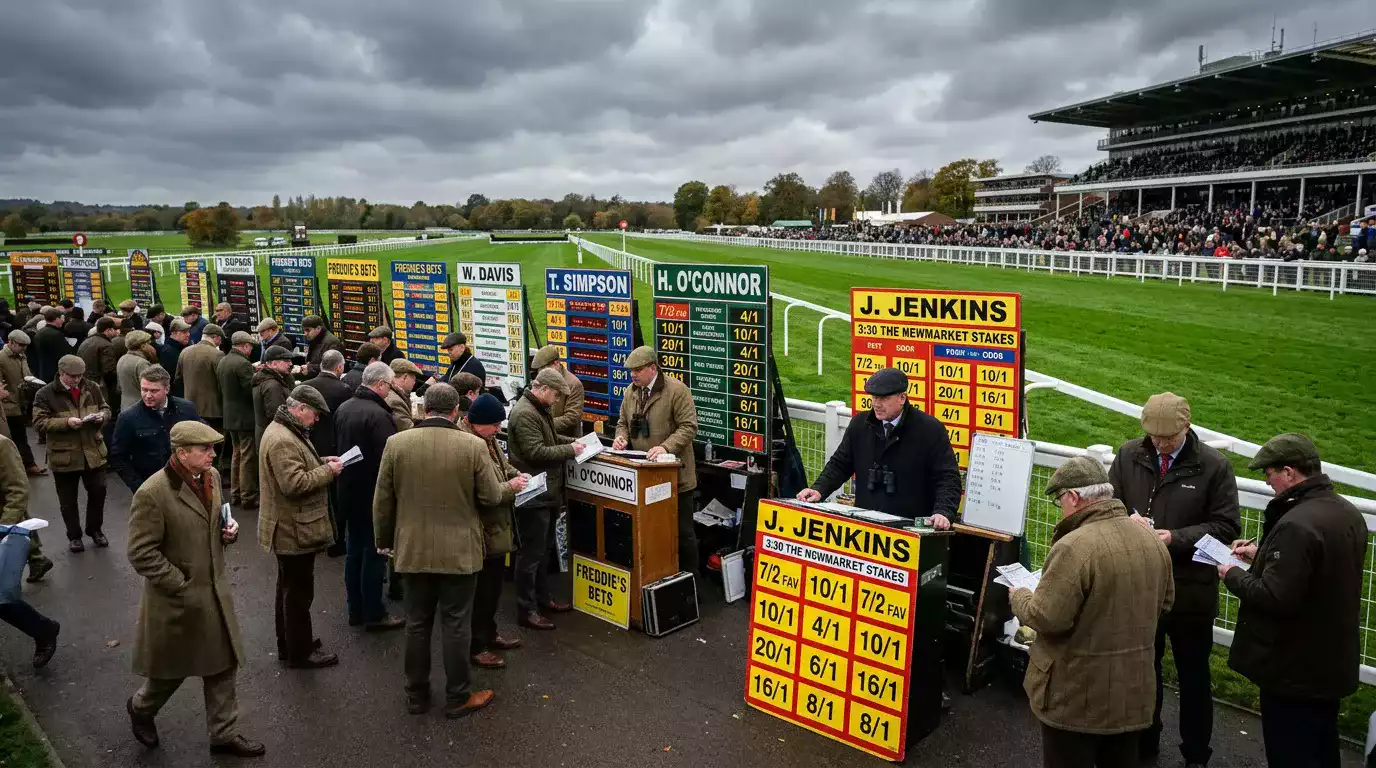
One of the first decisions you face on race day is whether to take the price currently on offer -- the board price -- or wait and settle at the Starting Price. The SP is the final odds on a horse at the moment the race begins, determined by the on-course market. It can be higher or lower than the price you saw that morning.
If a horse opens at 8/1 in the morning and is backed steadily through the day, the SP might come back at 5/1. You locked in at 8/1, so you collect at the better price. If the horse drifts out from 8/1 to 12/1 because money flows elsewhere, you are stuck with 8/1 while the SP bettors get the longer price. Neither approach is universally better -- it depends on your view of the market and whether you think the early price represents the horse's true chance.
In the first quarter of 2025, turnover on core fixtures fell by 14.4% year-on-year while premier fixtures held steady. That gap matters for pricing. On a thin midweek card, early prices can be volatile because the market is shallow -- a few sizeable bets can move a price by a full point. On a busy Saturday or a festival day, the early market is deeper and the price you take at 10am is more likely to reflect what the SP will return.
A practical rule: if you have a strong opinion on a horse and the morning price looks generous, take it. If you are unsure and the race has a large field with uncertain form, waiting for the off lets you see how the market settles. There is no formula that replaces judgement, but taking an early price on a horse you have studied is usually better than hoping the SP drifts in your favour.
Best Odds Guaranteed and What It Actually Protects
Best Odds Guaranteed -- BOG -- is the one bookmaker feature that genuinely shifts value towards the punter, and it costs nothing to use. If you take an early price on a horse and the SP is higher, a bookmaker offering BOG pays you at whichever price is greater. You get the best of both worlds: the security of locking in a price early, with the upside of a higher SP if the horse drifts.
Not every bookmaker offers BOG on every race. Most restrict it to UK and Irish racing, exclude ante-post markets, and may cap the maximum price at which it applies. Some operators have pulled BOG from certain meetings or reduced the ceiling in response to the broader margin squeeze -- overall turnover on British racing has been falling, and bookmakers are protecting revenue where they can.
BOG is not a promotion. It is a structural feature that changes the maths of early-price betting. Without it, taking an early price carries the risk of missing an SP drift. With it, that risk disappears. If your bookmaker does not offer BOG on the race you are betting, think carefully about whether you want to take the board price at all -- or wait for the off and settle at SP.
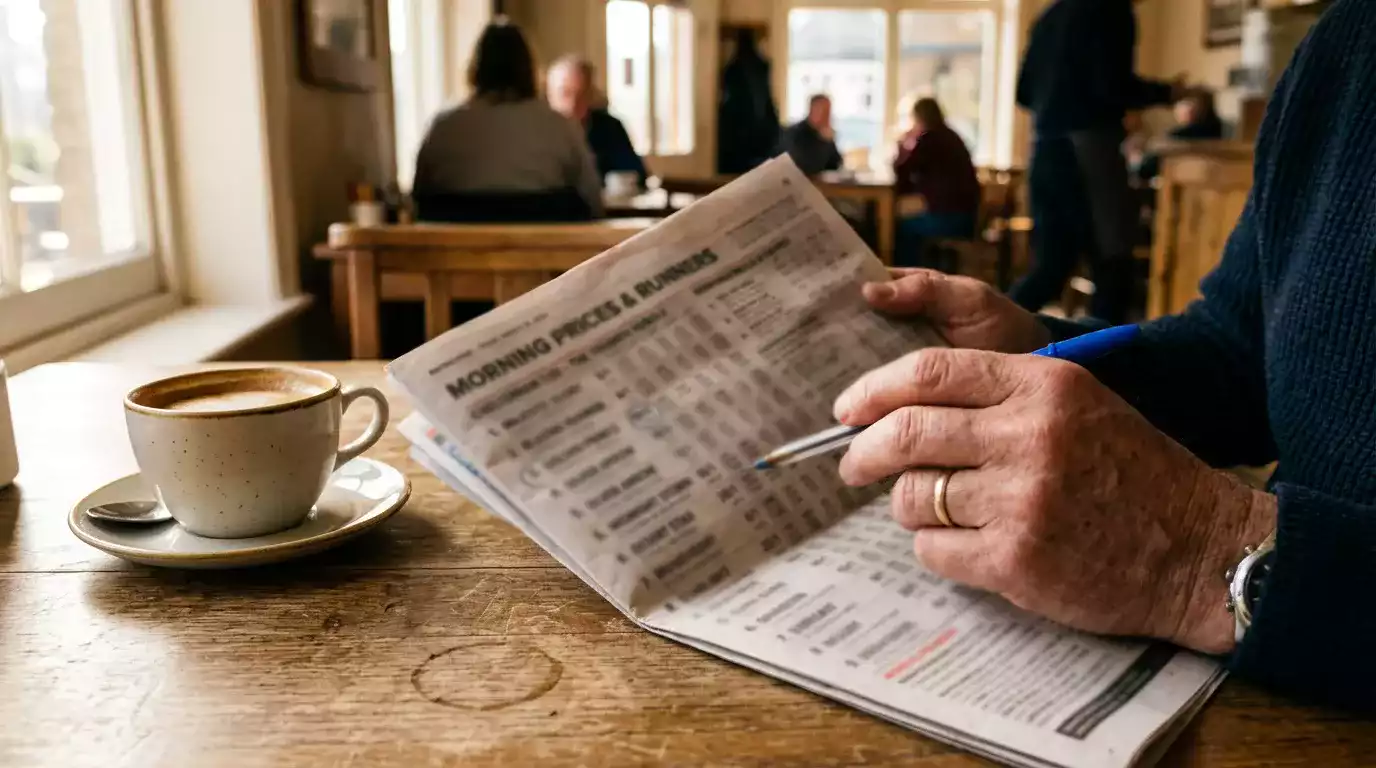
Over a full season, BOG can add meaningful percentage points to your return. The effect is largest when you bet early and often on prices that drift -- exactly the profile of a punter who studies form and takes a position before the casual market arrives.
Where Value Hides in the Market
Value is the gap between what you think and what the market thinks. If you believe a horse has a 25% chance of winning and the market prices it at 5/1 (implied 16.7%), the market is underestimating the horse by almost 8 percentage points. That is value. If you believe the horse has a 12% chance and the price is 5/1, the market is roughly right and the bet is neutral at best.
Finding value is not about picking winners. A horse at 10/1 that wins once in every eight attempts is a value bet, even though it loses seven times out of eight. The maths works because when it does win, the payout more than compensates for the losses. This is the hardest idea for new punters to accept: a profitable bettor can have a lower strike rate than someone who backs short-priced favourites and still come out ahead over a season.
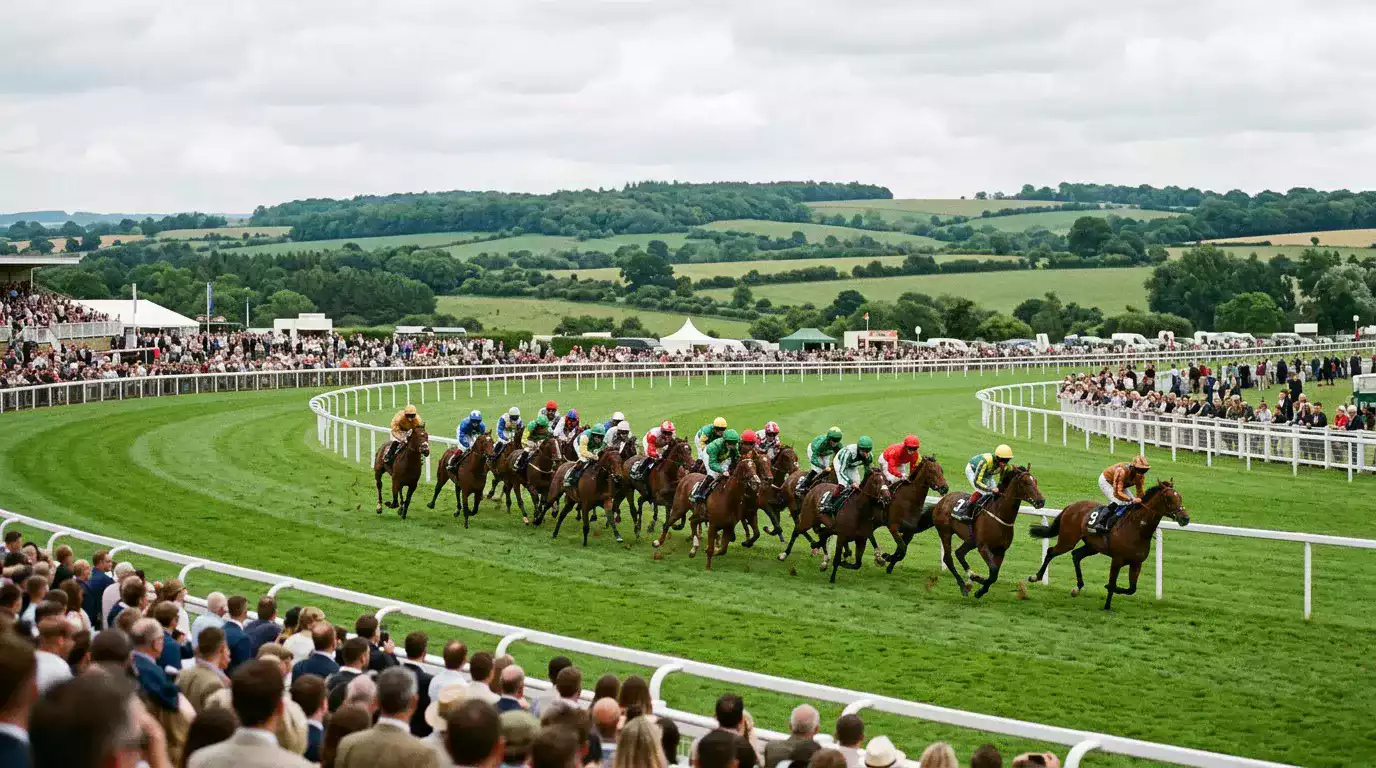
The sport is drawing new audiences -- junior attendance at British racecourses grew 17% in 2025, reaching over 211,000. Many of those newcomers will place their first bets on the big days, where the market is at its most competitive and the overround is at its lowest. That is not a coincidence. The best place to learn about value is also the place where value is most visible: large-field handicaps at festivals, where the bookmaker's margin is spread thin across 16 or more runners and the pricing of each horse reflects genuine uncertainty.
Start a simple record: write down the implied probability of every bet you place and the price you took. After 50 bets, compare your strike rate against the implied probability. If your winners are coming in at a higher rate than the odds predicted, you are finding value. If not, the market is pricing things better than you are.
Putting It Together: Three Worked Examples
Theory is only useful when it survives contact with a racecard. Here are three calculations that cover the situations you will encounter most often, worked through step by step.
Example 1: Win bet at fractional odds
You back a horse at 9/2 with a £15 stake.
Profit = £15 x (9 / 2) = £15 x 4.50 = £67.50
Total return = £67.50 + £15 stake = £82.50
Implied probability = 2 / (9 + 2) = 2/11 = 18.2%
Your view: you think this horse has a 25% chance. The price is offering value.
Example 2: Comparing two prices on the same horse
Bookmaker A offers 7/2 (decimal 4.50, implied 22.2%). Bookmaker B offers 4/1 (decimal 5.00, implied 20.0%).
On a £10 stake, Bookmaker A returns £45. Bookmaker B returns £50. The difference is £5 -- on a single bet.
Over 100 bets at this margin, you leave £500 on the table by not shopping for the best price.
Example 3: Each-way odds and the place fraction
You place £10 each-way (total outlay £20) on a horse at 8/1, with place terms of 1/4 odds for the first three places in a 12-runner handicap.
Win part: £10 at 8/1 = £80 profit + £10 stake = £90.
Place part: £10 at 1/4 of 8/1 = £10 at 2/1 = £20 profit + £10 stake = £30.
If the horse wins: total return = £90 + £30 = £120 on a £20 outlay. Profit = £100.
If the horse places but does not win: return = £30 on a £20 outlay. Profit = £10.
For the full mechanics of each-way value across different field sizes, the each-way guide goes deeper into place terms and when doubling your stake is justified.
Questions Punters Ask About Racing Odds
What does "odds-on" mean in practical terms?
A horse is odds-on when the market considers it more likely to win than to lose. The fractional price has a smaller number on the left than on the right -- 4/6, 1/2, 1/3. The payout is less than your stake: at 4/6, you risk £6 to win £4 profit. Odds-on horses win more often than not, but the returns are slim, and a single loss can wipe out several wins. Backing odds-on favourites consistently is a losing strategy unless your strike rate is exceptionally high.
How does the bookmaker make money if odds reflect probability?
Odds do not perfectly reflect probability -- the bookmaker inflates the implied probabilities across the field so they add up to more than 100%. The difference between 100% and the total is the overround, which is the bookmaker's theoretical profit margin. A typical race on a core fixture might carry an overround of 10-15%, meaning for every £100 wagered across all outcomes, the bookmaker expects to retain £10 to £15 before costs. On premier fixtures the overround is usually tighter, sometimes as low as 5-6%.
When does the starting price beat the board price, and vice versa?
The SP beats the board price when a horse drifts -- when money flows towards other runners and your selection's price lengthens between the time you could have bet and the off. The board price beats the SP when a horse is backed in -- when market confidence grows and the price shortens. There is no reliable way to predict which will happen, which is why Best Odds Guaranteed exists: it pays you whichever price is higher, removing the need to guess.
Why is Best Odds Guaranteed only offered on certain races?
BOG is a cost to the bookmaker: every time the SP exceeds the price a punter took, the operator pays the difference. Bookmakers limit this cost by restricting BOG to UK and Irish racing, excluding ante-post markets (where the gap between early price and SP can be enormous), and sometimes capping the maximum price at which it applies. Horse racing betting generated £766.7 million in remote gross gambling yield in the most recent financial year, but turnover has been falling. As margins come under pressure, some operators have quietly tightened their BOG terms -- checking the small print before you bet is not paranoia, it is arithmetic.
Read also


Created by the "Furlongcraft" editorial team.
