
Starting Price Explained: How The Final Market Price Is Built
 Available in US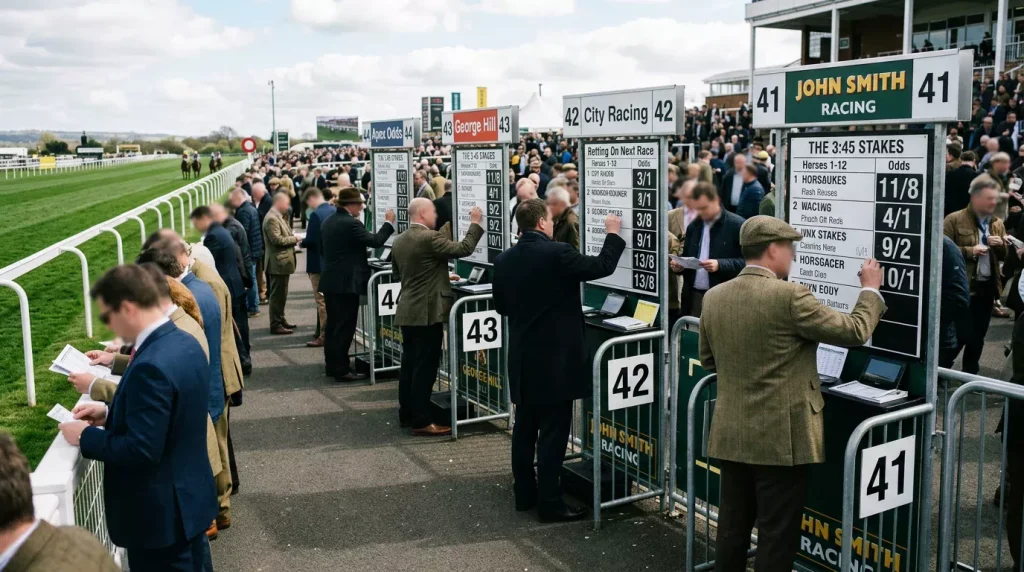
The Number That Settles Everything
I watched a race at Newmarket where a horse opened at 5/1 on the boards, drifted to 8/1 inside the final five minutes, and then shortened back to 6/1 by the off. Three different prices in ten minutes, and the only one that mattered for thousands of punters was the last one – the starting price. SP is the single most important number in British racing if you have not locked in an early price, and yet most punters have only a vague idea of how it is determined.
The starting price is the official odds at which a horse starts a race, and it is the price used to settle bets for anyone who took SP rather than a fixed early price. It is not a bookmaker’s invention or a computer’s estimate. It comes from the on-course betting ring, determined by human beings standing on stools with chalk and boards.
Starting Price Explained — More on this topic at horse racing betting how to .
What SP Is
SP stands for starting price. It is the final set of odds available on each runner at the moment the race begins. In the UK, SP is calculated by an independent body – currently a panel of representatives from the Starting Price Regulatory Commission – by surveying the prices displayed by on-course bookmakers at the track immediately before the off.
When you place a bet and choose “SP” rather than taking the current board price, you are agreeing to accept whatever price the market settles on at race time. This can work for you or against you. If money piles in on your horse late and the price shortens, SP will be shorter than the board price you could have taken earlier. If your horse drifts – if money moves elsewhere and the price gets bigger – SP will be longer, and you benefit.
SP exists because British racing has a long tradition of on-course betting, and the ring remains the reference market for pricing. Even though the vast majority of betting now happens online, SP is still anchored to what happens physically at the track.
How SP Is Calculated
The process is less glamorous than the name suggests. Before each race, SP reporters from the regulatory commission survey the prices displayed by on-course bookmakers in the Tattersalls ring – the main betting enclosure at British racecourses. They record the odds available from a representative sample of bookmakers at the moment the starter calls the field into line.
The reported SP is typically the most commonly available price across those bookmakers, adjusted for any outliers. If five on-course bookmakers show 7/1 and one shows 6/1, the SP is 7/1. The process is manual, traditional, and remarkably low-tech for a market that moves billions of pounds annually.
One detail that surprises most punters: the on-course ring is a tiny fraction of total betting activity. The overwhelming majority of money is bet online, but SP is still set by what happens in a physical enclosure at the track. This creates occasional disconnects between the exchange price, the online bookmaker price, and SP. A horse might be 5/1 on the exchanges, 9/2 with the online bookmakers, and 5/1 SP – three different numbers for the same horse in the same race.
Total betting turnover on British racing fell 4.3% in 2025 relative to 2024. Within that decline, the gap between premier and core fixtures widened: turnover per race on premier fixtures grew by 1.1%, while core fixtures dropped 8.1%. SP markets at smaller meetings are thinner and more volatile as a result.
See also Tote Betting Explained .
Board Price Vs SP
Every punter faces this choice at some point: take the price on the board now, or wait for SP. I have got this wrong in both directions enough times to have formed a view.
The board price is the fixed odds offered by an online bookmaker at a given moment. If you take it, that price is locked in regardless of what happens to the market before the race. SP is what the market settles on at the off. The decision between the two depends on market direction – and market direction depends on information flow.
Horses that attract late money – sometimes called “steamers” – shorten into the off. If you suspect your horse will be popular, taking the early board price protects you from a contraction. Horses that “drift” – moving to a bigger price as other runners attract support – will give a better SP than the early board price. The problem is that predicting market movement is its own skill, separate from picking winners.
A practical rule I use: if I have done my own form analysis and arrived at a selection before the market has moved significantly, I take the board price. If I am betting reactively – responding to a late tip or a market signal – I take SP, because any board price I grab at that moment is already partially adjusted. The worst outcome is taking a board price on a drifter and watching SP settle two points longer than what I locked in.
Taking SP Strategically
SP is often dismissed as the lazy option, and in many cases it is. But there are situations where SP is the smarter play.
At smaller meetings with thin on-course markets, SP can be volatile and occasionally generous. On-course bookmakers at a midweek Sedgefield fixture are pricing a small pool of bets, and a single large wager can push the price of a rival in, leaving your horse at a longer SP than the online market suggested. This is unpredictable but it happens often enough to notice.
SP also removes the temptation to time the market – a game that costs more punters money than it makes. If you take the early price and it drifts, you feel you overpaid. If you wait for SP and it shortens, you feel you missed out. Both feelings erode discipline. SP, for all its randomness, at least removes that second-guessing loop.
For punters using Best Odds Guaranteed promotions, the distinction partly dissolves. BOG gives you the better of your board price and SP, which is effectively a free option on market movement. Where BOG applies, there is almost no reason to take SP deliberately – you should take the board price and let BOG upgrade it if SP is longer. Understanding this intersection is part of reading horse racing odds effectively.
Late Withdrawals And Their Effect On SP
When a horse is withdrawn close to the off – after the final declarations but before the race starts – the remaining runners’ SP is affected. The withdrawal removes one competitor, concentrating the market. If the withdrawn horse was a well-backed favourite, the reshuffling can be significant, shortening the remaining prices and triggering Rule 4 deductions on bets already placed at fixed prices.
For punters on SP, a late withdrawal is a double-edged situation. Your SP will reflect the recalculated market, which typically means a shorter price on each remaining runner. You do not face a Rule 4 deduction – that applies to fixed-price bets – but you do accept a compressed market. If the withdrawn horse was an outsider, the effect on SP is minimal. If it was the 6/4 favourite, every other price in the race shrinks materially.
This is one of the less obvious costs of taking SP on busy days. A single late withdrawal can knock a point or more off your effective price without you having done anything differently. Board-price punters face Rule 4 instead, which is a fixed mathematical deduction – often a fairer outcome than the market compression that hits SP.
Articles
Prepared by the Furlongcraft editorial staff.
