
Each-Way Betting In Horse Racing: How Place Terms And Field Size Decide The Value
 Available in US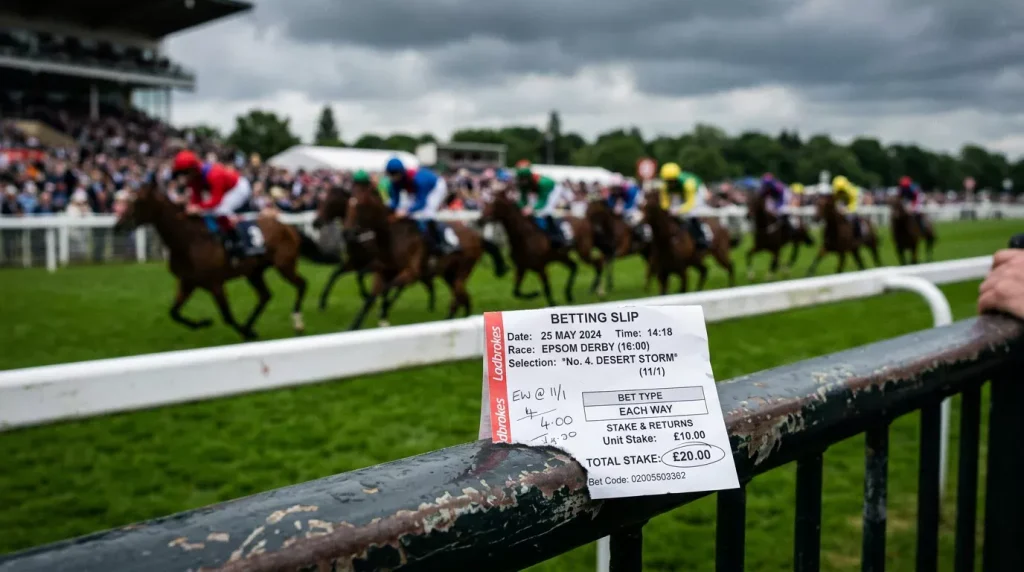
I backed a horse each-way at Cheltenham a few years ago — 14/1 in a race with seven runners. It finished second. I was expecting a decent consolation return and instead collected barely enough to cover the stake. The problem was not the horse, or the price, or even bad luck. The problem was that I had not checked the place terms. Seven runners meant only two places paid, and the fraction was 1/4 of the odds. My “safety net” had a hole in it the size of a barn door, and I only noticed after the race was over.
Each-way betting is the most misunderstood bet type in UK racing. It looks simple — back a horse to win and place — but the value depends entirely on two variables that most punters ignore: the number of runners and the place fraction. Get those right, and each-way is one of the sharpest tools in a punter’s kit. Get them wrong, and you are paying double the stake for insurance that barely covers anything. This guide breaks down every moving part, from where each-way sits in the wider bet-type family to the specific scenarios where it offers genuine mathematical value.
What An Each-Way Bet Actually Is
An each-way bet is two separate bets on the same horse: a win bet and a place bet. The total stake is double the unit stake — a “£5 each-way” bet costs £10 (£5 to win, £5 to place). If the horse wins, both bets pay out. If the horse places but does not win, you lose the win portion and collect on the place bet. If the horse finishes outside the places, you lose both.
The win portion pays at the full advertised odds, exactly as a normal win single would. The place portion pays at a fraction of the win odds, determined by the place terms for that specific race. Those terms are not negotiable or variable — they are set by the bookmaker based on the number of runners and the race type, and they are published before the race starts.
The critical thing to internalise is that the place portion is not “bonus money” or “insurance.” It is a separate bet with its own odds, its own expected value, and its own contribution to the overround. Treating it as a safety net rather than as a calculated position is how punters end up in the situation I described at Cheltenham — paying double the stake for a place return that barely covers the outlay.
Each-way betting exists because it solves a genuine problem. In a 20-runner handicap, your selection might have a 5% chance of winning but a 25% chance of finishing in the first four. A win-only bet captures none of that broader expectation. An each-way bet lets you profit from the full range of competitive finishes, which is why it has survived for over a century in British racing while other bet types have come and gone. The structure is not arbitrary — it is a calibrated response to the uncertainty built into large, competitive fields.
Each-Way Betting In Horse Racing — More on this topic at horse racing betting how to .
Place Terms By Number Of Runners
This is the section that determines whether an each-way bet is smart or wasteful. Place terms shift with field size, and the differences are significant enough to turn a value bet into a losing proposition.
| Runners | Places Paid | Place Fraction |
|---|---|---|
| 2-4 | No each-way available | — |
| 5-7 | 1st, 2nd | 1/4 odds |
| 8+ | 1st, 2nd, 3rd | 1/5 odds |
| 12-15 (handicap) | 1st, 2nd, 3rd | 1/4 odds |
| 16+ (handicap) | 1st, 2nd, 3rd, 4th | 1/4 odds |
Average field sizes tell you how often these different brackets apply. Flat racing averaged 8.9 runners per race in 2025, down from 9.14 in 2024. Jumps racing averaged 7.84, down from 8.49. That decline matters because it pushes more races into the 5-7 runner bracket where only two places pay and the fraction is 1/4 — the least favourable each-way terms.
Field sizes on premier jump fixtures in Q1 2025 actually grew, from 9.29 to 9.63 runners on average, while core fixtures shrank marginally from 7.85 to 7.93. The implication for each-way punters is clear: the big meetings offer better structural conditions for each-way betting than the midweek cards. More runners means more places paid, which means the place portion of your bet carries a higher probability of returning something.
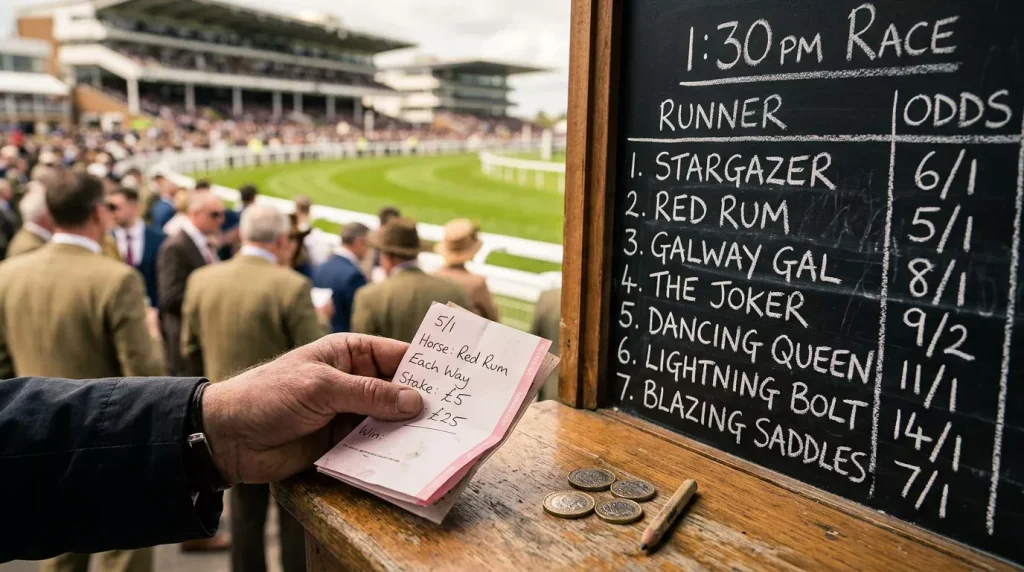
The gap between 1/5 and 1/4 place fractions is often overlooked. A horse at 10/1 in a non-handicap with eight runners pays place odds of 10/1 x 1/5 = 2/1. The same horse in a handicap with twelve runners pays 10/1 x 1/4 = 5/2. That half-point improvement in the place odds can be the difference between a place return that covers your total outlay and one that falls short.
Handicap Place Terms: Where The Extra Place Lives
Handicaps are the each-way punter’s natural habitat. Large fields, competitive pricing, and — crucially — enhanced place terms that extend the safety net from three places to four in fields of sixteen or more. Those extra-place terms flip the arithmetic in the punter’s favour more often than any other structural feature of UK racing.
Consider a 20-runner handicap at Newbury. Your selection is priced at 12/1. The place terms are 1/4 odds on the first four finishers. The place portion of a £5 each-way bet pays (12/1 x 1/4) x £5 = 3/1 x £5 = £15 profit + £5 stake = £20 — from the place alone. Your total outlay was £10. If the horse finishes anywhere from first to fourth, you are in profit. First to fourth from twenty runners is a 20% probability if all horses were equal — and your horse, if it genuinely deserves a price of 12/1, has an implied win probability of 7.7%, making the place probability considerably higher.
Handicaps above sixteen runners are where each-way value concentrates. The fourth-place provision turns horses at 8/1 and longer into place bets with a meaningful expected return. Below sixteen runners, the terms revert to three places, and the value diminishes sharply. I keep a simple rule: I only bet each-way in handicaps when the field has sixteen or more runners and my selection is 8/1 or longer. Below either threshold, I default to a win single.
See also Affordability Checks On UK Betting .
Calculating Your Each-Way Payout
The arithmetic is not complicated once you separate the two bets. I will walk through a full example and then a shortcut method.
You back a horse at 9/1 each-way for £5 in a 16-runner handicap (1/4 odds, four places). Total stake: £10.
If the horse wins: win portion = (9/1 x £5) + £5 stake = £45 + £5 = £50. Place portion = (9/1 x 1/4 x £5) + £5 stake = (9/4 x £5) + £5 = £11.25 + £5 = £16.25. Total return: £50 + £16.25 = £66.25. Profit: £66.25 – £10 outlay = £56.25.
If the horse places (second, third, or fourth): win portion lost (-£5). Place portion = £16.25. Total return: £16.25. Profit: £16.25 – £10 outlay = £6.25.
The shortcut: for the place return, divide the win odds by the place fraction denominator. At 9/1 with 1/4 terms, the place odds are 9/4. Then treat it as a normal single at those odds. This avoids the multi-step calculation and gives the same answer in one pass.
Where punters go wrong is forgetting that the total stake is double the unit. A £5 each-way bet costs £10, and the profit calculation must account for that full £10 outlay, not just the £5 win portion. Understating the outlay by half makes every each-way bet look twice as profitable as it actually is.
Here is a second example to reinforce the point, this time in a smaller field. You back a horse at 6/1 each-way for £10 in a seven-runner non-handicap. Total stake: £20 (£10 win, £10 place). Place terms: 1/4 odds, two places only. If the horse wins: win return = (6 x £10) + £10 = £70. Place return = (6/4 x £10) + £10 = £15 + £10 = £25. Total: £95. Profit: £75. If the horse finishes second: win lost (-£10). Place return = £25. Profit from a £20 outlay: £5. Five pounds profit on a twenty-pound bet that required a specific finishing position. Compare that to the 16-runner handicap example above, where a place return at 9/4 yielded £16.25 from a £10 outlay. The field size and place terms created a completely different risk-reward profile on similar odds. This is why I keep coming back to the same point: the race conditions matter more than the price on the board.
When Each-Way Betting Is Genuine Value
Not every each-way bet is a smart one. The value depends on a specific alignment of price, field size, and place terms — and most races do not offer that alignment. Richard Wayman, the BHA’s Director of Racing, has observed that betting activity remains under pressure, with turnover falling year on year. That pressure concentrates in exactly the markets where casual each-way punters tend to operate: mid-range prices in medium-sized fields where the place terms are tight and the overround is high.
Each-way is genuine value in three specific scenarios. First, when a horse’s place probability is significantly higher than the implied place probability in the each-way odds. This happens most often with horses that have strong form for finishing in the frame but lack the finishing speed to win — the so-called “each-way thieves” that trainers place deliberately in large-field handicaps. These horses run consistently well enough to hit the frame but rarely dominate. At 12/1 or 14/1 in a 20-runner handicap, the win price reflects low win probability, but the place odds can represent genuine value because the horse’s consistency means it finishes in the first four far more often than a 12/1 win price implies.
Second, when a horse is priced at 8/1 or longer in a handicap with sixteen or more runners and four places. The fourth-place provision makes the place portion a bet with a positive expected value in its own right. Third, in races where a short-priced favourite makes the win market uncompetitive but distorts the place odds of longer-priced runners. If a 1/3 favourite occupies one of the place slots almost certainly, the remaining place slots have higher effective probabilities for the rest of the field. In those cases, backing a 10/1 shot each-way is effectively betting on it to fill one of two or three genuinely open place slots, not one of three or four — the favourite has already claimed one.
When Each-Way Betting Is Poor Value
Small fields kill each-way value. In a race with five, six, or seven runners, only two places pay, and the fraction is 1/4 of the odds. A horse at 4/1 in a six-runner race has place odds of 1/1 (evens) — you are risking £5 to win £5 on the place, and you need the horse to finish first or second from six. The win bet might be fine; the place bet is paying you even money on a proposition that has roughly a 33% chance if the field is competitive. That is a losing bet over time.
Short-priced each-way bets are equally problematic. A horse at 2/1 each-way in an eight-runner non-handicap has place odds of 2/5 (1/5 of the win price). You are staking £5 to win £2 on the place. Even if the horse places, the place return barely dents the total outlay. At prices of 3/1 and below, the place portion adds so little to the return that you are essentially paying double the stake for a bet that behaves almost identically to a win single.
Turnover differences between premier and core fixtures underscore where each-way value concentrates and where it thins out. On premier fixtures in 2025, the average turnover per race rose 1.1%. On core fixtures, it fell 8.1%. That divergence reflects, in part, punters gravitating to the bigger fields and better place terms available at major meetings — and stepping away from the smaller, tighter cards where each-way betting is structurally disadvantaged.
Extra-Place Promotions: Reading The Fine Print
Bookmakers regularly offer “extra places” on selected races, paying out on one more place than the standard terms. A race that would normally pay three places gets extended to four; a sixteen-runner handicap paying four places gets extended to five. These promotions are concentrated around major festivals and big Saturday cards — events where the bookmaker wants to attract volume and is willing to sacrifice margin on place payouts to do so.
Extra-place offers shift the each-way equation meaningfully. An additional place in a 20-runner field raises the place probability from roughly 20% to 25% (assuming equal runners), while the place odds remain the same. That is free value — a structural advantage handed to the punter. I track extra-place offers across three or four firms and specifically target races where the additional place creates a genuine edge on a horse I was already considering.
The fine print matters. Some firms offer extra places only on specific bet types (each-way singles, not multiples). Some cap the maximum payout. A few restrict the offer to new customers or exclude BOG combinations. Reading the terms takes less than a minute and can save a frustrating conversation with customer service after the race.
Each-Way Betting At The Big Festivals
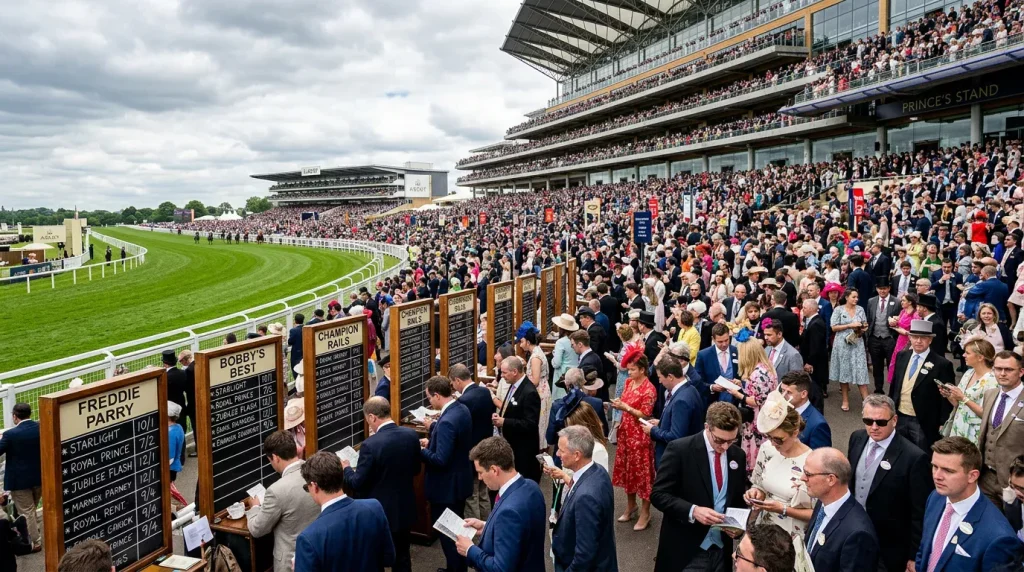
Festival racing is where each-way betting comes alive. The Grand National fields 40 runners with four places at 1/4 odds — the most generous standard terms in the calendar. Cheltenham’s championship handicaps routinely draw fields of twenty or more. Royal Ascot’s big handicaps — the Wokingham, the Royal Hunt Cup, the Buckingham Palace — attract massive fields and correspondingly generous place structures. Around 82% of bets on the Grand National are £5 and under, and the majority of those are each-way.
The danger at festivals is overextending. Four days at Cheltenham with six races a day means twenty-four opportunities to bet each-way. At £5 each-way per race, that is £240 in stakes over four days. Even with reasonable strike rates, the variance across that many bets is enormous. I set a per-day budget at festivals rather than a per-race budget — it forces prioritisation. If I am going to bet each-way on six races across a festival day, the average stake needs to be small enough that the total stays within bounds.
The Grand National deserves separate mention because it attracts around 12 million bettors in the UK alone, roughly 30% of whom are first-timers or returning after a long break. For that audience, a £5 each-way bet on a 25/1 shot is the defining racing experience: modest outlay, narrative engagement across four minutes of action, and a genuine shot at a meaningful return if the horse finishes in the first four. It is one of the few contexts where each-way is not just good value but the right bet type for the moment.
The Each-Way Questions Worth Settling
Four questions arise so frequently in each-way conversations that they deserve direct answers rather than footnotes.
When a favourite is withdrawn from a race, Rule 4 deductions may apply to the win portion of your bet, reducing the payout by a percentage that depends on the withdrawn horse’s price. The place portion is also affected if the withdrawal changes the number of runners enough to alter the place terms — for example, if a race drops from eight runners to seven, the places paid shrink from three to two. Checking the final declared runners before the off protects you from this scenario.
Betting each-way on a short-priced favourite is almost never worthwhile. At 2/1 in an eight-runner race, the place odds are 2/5 — a £5 place bet returns £7 (£2 profit). Your total outlay is £10 for a win-and-place bet that returns £17 if the horse places but does not win. The place portion adds so little that you are better served by a straight win single at the full price. Each-way at short prices is paying for insurance that barely covers the premium.
Extra-place offers across multiple bookmakers are worth chasing, but only if you are disciplined about it. Opening accounts with several firms to access their respective extra-place offers is a legitimate strategy, provided you track your stakes centrally. The danger is that spreading bets across six bookmakers makes it harder to monitor total spending — and bookmakers design their promotions to encourage exactly that kind of distributed, less-visible outlay.
Dead-heats in place positions are settled by dividing the place payout proportionally. If two horses dead-heat for third in a race paying three places, each receives half the third-place payout. Your each-way return is calculated at the full place odds but for only half the stake, because only half of your place bet is deemed to have won. Dead-heats are rare enough not to affect strategy, but understanding the settlement rule prevents confusion when it happens.
Articles
Written by the editors at Furlongcraft.
