
Horse Racing Bet Types Explained: From Win Singles To Exotic Multiples
 Available in US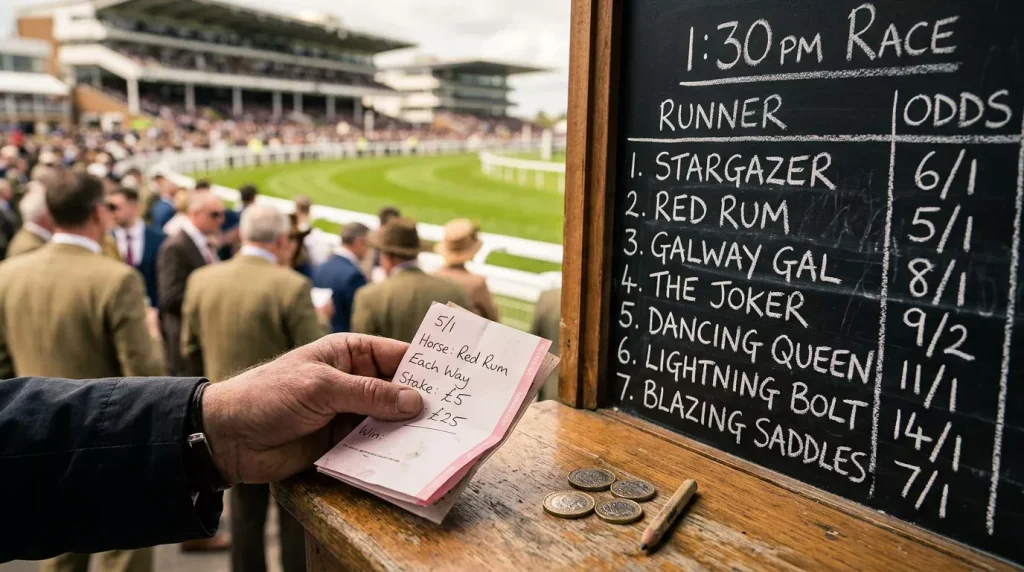
The first time someone handed me a betting slip with “Lucky 15” printed across the top, I assumed it was a brand name — like a scratch card or a lottery game. It took an embarrassingly long conversation with the cashier at a Coral shop in Epsom to learn that a Lucky 15 is fifteen separate bets derived from four selections. Fifteen bets. From four horses. I had planned to spend four pounds and nearly spent sixty.
UK horse racing offers more bet types than any other sport in the country, and the range exists for a reason. Different bets suit different situations — field size, race quality, your confidence level, your bankroll. A win single on a 2/1 shot is a completely different proposition from a tricast in a 20-runner handicap, even if both cost the same to place. This guide runs through every bet type you will encounter in British racing, from the simplest to the most complex, with the maths and the logic behind each. The online remote betting market for horse racing generates £766.7 million in gross gambling yield, and a meaningful chunk of that comes from punters choosing bet types without fully understanding what they have signed up for.
Horse Racing Bet Types Explained — More on this topic at horse racing betting how to .
The Win Single: One Horse, One Question
Does this horse finish first? That is the entire question. A win single is the purest bet in racing — one selection, one outcome. You pick a horse, choose your stake, and either the horse wins or it does not. No place terms, no combinations, no cascading outcomes. The return is your stake multiplied by the odds, plus your stake back.
Win singles are the foundation of every serious punter’s approach. They carry the lowest house edge of any bet type because there is no structural complexity for the bookmaker to hide margin inside. A £10 win bet at 5/1 returns £60 if it wins and nothing if it loses. The maths is transparent, the outcome is binary, and the bookmaker’s only edge comes from the overround built into the price itself.
I have met punters who regard win singles as boring — not enough moving parts, not enough excitement. That attitude is a gift to the bookmaker. Every layer of complexity you add to a bet — place terms, multiple legs, combination structures — adds opportunities for the margin to compound. Win singles strip all of that away. If you believe a horse is overpriced at 7/2 and you are right over the long run, win singles are the cleanest vehicle for converting that belief into profit.
The discipline of singles also forces clarity of thought. When you can only back one horse to win, you cannot hedge your uncertainty across a Lucky 15 or disguise weak selections inside an accumulator. Either you have a view on the race or you do not. That constraint, more than anything, is what separates recreational punters from methodical ones.
Place-Only Bets: Backing The Podium
A place bet asks a softer question: will this horse finish in the top two, three, or four, depending on the number of runners? The payout is lower than a win bet because the probability of placing is higher than the probability of winning. Place odds are derived from the win odds using a fraction — typically 1/4 or 1/5 of the win price — combined with the place terms set by the bookmaker.
Place-only bets are less common than each-way bets, which combine a win and a place bet into a single wager. But they exist as a standalone option, and they are worth understanding separately. In a race with eight or more runners (non-handicap), the standard place terms are first, second, or third at 1/5 of the win odds. In handicaps with sixteen or more runners, place terms often extend to fourth, sometimes at 1/4 odds.
When do place-only bets make sense? Rarely, if I am honest. The odds are structured to favour each-way betting in most scenarios, because the each-way bet gives you a shot at the full win price alongside the place insurance. A standalone place bet only appeals when you are confident a horse will finish in the frame but believe it lacks the quality or pace to win outright. That is a narrow assessment to make accurately, and most punters are better served by either backing the horse to win at full odds or going each-way.
Forecast Bets: Predicting The Order
I once landed a computer straight forecast at Cheltenham that paid £187 from a £2 stake. The two horses I picked finished first and second, in the exact order I had predicted. The elation lasted until a friend pointed out that the reverse forecast — which would have paid regardless of which of the two finished first — would have covered both permutations for £4 total and still returned handsomely. He was right. I had been lucky, not clever.
A straight forecast requires you to name the first and second finisher in the correct order. A reverse forecast covers both permutations — your two selections in either order — for double the stake. A combination forecast extends this to three or more horses, covering all possible first-second pairings. With three selections, that is six bets. With four, it is twelve.
Forecast dividends in UK racing are calculated by a computer algorithm — the Computer Straight Forecast (CSF) — rather than by fixed odds. The algorithm takes into account the starting prices of all runners and produces a dividend that reflects the difficulty of the prediction. This means you do not know the exact payout when you place the bet; you only find out after the race. In practice, CSF dividends tend to be generous in large fields where the first two home are at longer prices, and modest in small fields dominated by short-priced favourites.
The strategic appeal of forecasts lies in races where you have a strong view about the order of finish, not just the winner. If you believe a 4/1 shot will beat a 3/1 shot but both will finish ahead of the favourite, a straight forecast lets you profit from that precise opinion. If you are less certain about the order but confident both will feature, the reverse forecast is the cleaner option. Either way, forecasts reward specific thinking. They are not a bet for someone who vaguely fancies “one of these three.”
Tricast Bets: First, Second And Third In Sequence
If a forecast is hard, a tricast is an order of magnitude harder — and the payouts reflect that difficulty. A tricast requires you to name the first, second, and third finishers in the exact order. The Computer Tricast (CT) dividend replaces fixed odds, just as with forecasts, and the returns can be remarkable. Four-figure payouts from a £1 stake are not uncommon in big-field handicaps where three outsiders fill the places.
Tricasts are available in races with eight or more declared runners — a minimum field size that exists because the probability of correctly naming three finishers in order becomes statistically meaningful only when there are enough runners to make the outcome genuinely uncertain. In smaller fields, the bookmaker simply does not offer tricasts because the dividends would be too low to justify the bet.
Combination tricasts cover all possible orderings of three, four, or more selections. Three horses generate six permutations, four horses generate twenty-four, and five horses generate sixty. The stake multiplies accordingly: a £1 combination tricast on four horses costs £24. This is where the maths catches up with the ambition. Unless you are genuinely confident about a group of horses finishing ahead of the rest, the escalating cost of combination tricasts turns them into expensive lottery tickets.
My own approach to tricasts is selective. I use them only in large-field handicaps where I have identified three horses I believe are significantly overpriced, and where the favourite is vulnerable. In those situations, a small-stake combination tricast offers asymmetric risk: a modest outlay against a potentially large dividend. In any other context — short-priced fields, small runners, well-fancied market leaders — I leave tricasts alone.
See also Each-Way Betting In Horse Racing .
Doubles, Trebles And Accumulators
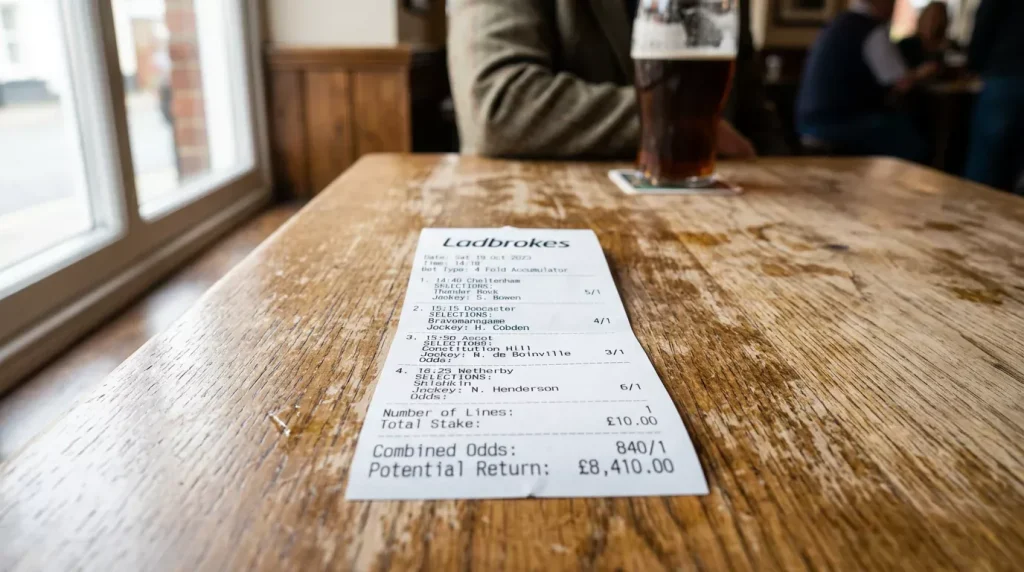
Multiple bets link two or more selections across different races into a single wager. A double covers two selections — both must win. A treble covers three. An accumulator (acca) covers four or more. The appeal is simple: the odds multiply. A double at 3/1 and 4/1 pays as if you had backed a single horse at 19/1. A four-fold at 2/1, 3/1, 2/1, and 5/1 pays at 143/1. The numbers look intoxicating on a betting slip.
The reality is less glamorous. Every leg you add to a multiple compounds the bookmaker’s margin. If each individual bet carries a 5% edge for the bookmaker, a four-fold compounds that edge to roughly 18.5%. By the time you reach a six-fold, the house edge can exceed 25%. You are paying a heavier hidden tax with every additional leg, and the bookmaker knows it — which is precisely why accumulator bets are so heavily promoted across the industry.
Doubles are the most defensible multiple. Two legs mean the margin compounds only once, and the uplift in odds can be significant enough to justify the extra risk. I use doubles when I have two strong opinions on separate races and want to combine them into a single, higher-paying bet. Trebles are viable if all three selections carry genuine edge. Beyond three legs, the compounding margin erodes the expected value so aggressively that accumulators become entertainment, not strategy.
None of this means accumulators are always wrong. A £2 five-fold for a Saturday afternoon at Ascot is a legitimate entertainment bet — you are spending two pounds on several hours of engagement across five races. The mistake is treating accumulators as a viable path to consistent profit. They are not, by design, and the maths is not debatable.
Cash-out options on accumulators add another layer. Most major bookmakers now offer the ability to cash out a multiple before the final leg runs, locking in a profit or cutting a loss. The cash-out price is always worse than the expected value of letting the bet ride, because the bookmaker takes a margin on the cash-out offer itself. It is a convenience fee, not a free service. Use it when the guaranteed money matters more to you than the expected value of the remaining leg — and recognise that the bookmaker profits from your impatience.
Full-Cover Bets: The Lucky 15 Family And Beyond
Full-cover bets are the baroque architecture of horse racing wagers — intricate, expensive, and occasionally spectacular. They take a set of selections and generate every possible combination of singles, doubles, trebles, and higher multiples. The most common full-cover bets are the Lucky 15 (four selections, fifteen bets), the Yankee (four selections, eleven bets — no singles), the Heinz (six selections, fifty-seven bets), and the Goliath (eight selections, 247 bets).
The Lucky 15 is the most popular, and for good reason. Four singles, six doubles, four trebles, and one four-fold accumulator. If only one horse wins, you collect on the single. If two win, you collect on both singles and the double. The structure means you can have three losers and still get a return. Most bookmakers sweeten the deal with bonuses: double odds on a single winner, and a percentage bonus if all four win. Those bonuses are the reason the “Lucky” prefix exists — they make the bet more attractive than its raw mathematics would suggest.
The cost is the catch. A £1 Lucky 15 costs £15. A £2 Lucky 15 costs £30. For that outlay, your four horses need to perform collectively, not individually. If you have four selections at an average of 5/1, the four-fold alone would return £1,296 from a £1 stake — but only if all four win. The probability of that happening, assuming the prices are fair, is roughly 0.08%. The singles and smaller multiples provide consolation returns, but they rarely recover the full outlay unless at least two selections win at reasonable prices.
Beyond the Lucky 15, the family escalates rapidly. A Heinz on six selections generates 57 bets. At £1 per bet, that is £57 invested. A Super Heinz on seven selections: 120 bets, £120 outlay. A Goliath on eight: 247 bets, £247. These are not casual wagers. They are structured portfolio plays that only make sense if you have a genuine edge across multiple races and the bankroll to absorb a losing day without blinking.
The Yankee occupies a middle ground. Same four selections as a Lucky 15, but without the four singles — so eleven bets instead of fifteen. The Yankee only pays if at least two of your selections win, because the smallest bet in the structure is a double. It costs less than a Lucky 15 but offers no safety net for a single winner. I prefer the Lucky 15 over the Yankee because the singles provide a return in the most common outcome — one winner from four — and the bonus structures make that single-winner scenario more tolerable.
Choosing The Right Bet Type For The Race
Bet type is not a personality trait — it is a tactical decision that should change with the race. A five-runner Group 1 at Ascot calls for a different approach than a 22-runner handicap hurdle at Wetherby, and treating them identically is one of the most expensive habits in racing.
Small fields with strong market leaders favour win singles. When there are five or six runners and a clear favourite, the pricing structure is tight, the overround is relatively low, and the question is straightforward: can this horse beat that horse? Forecasts become attractive in these conditions too, because the small field makes predicting the order of finish a realistic exercise rather than a lottery. Each-way betting in small fields is usually poor value because the place fraction is only paid on the first two, and the odds compress sharply.
Large-field handicaps — the bread and butter of midweek racing — open up the full range. Each-way bets at 10/1 or longer offer genuine place value in fields of sixteen or more, where the terms extend to fourth. Combination tricasts become viable when you have identified a cluster of overpriced runners. Even a small-stake accumulator across two handicaps can make sense if you view both as high-confidence value plays. Around 82% of bets on the Grand National are £5 and under, reflecting the fact that big fields naturally push punters towards small-stake exotic bets rather than large-stake singles.
The BHA’s analysis of the current market points to a structural shift that affects bet-type decisions directly. Fewer high-staking customers are active, driven in part by affordability checks, and they are being partially replaced by recreational punters who bet in smaller amounts primarily at the bigger meetings. That pattern favours each-way and multiple bets at festivals, where bookmakers extend place terms and offer enhanced promotions to attract volume. On quieter midweek cards, the market is thinner and prices move more sharply — conditions that favour quick, decisive win singles over complex structures.
How Bet Types Interact With Your Bankroll
A mate of mine burned through £300 in a single afternoon at Goodwood — not because he picked badly, but because he placed six Lucky 15s at £2 per line. Six times fifteen bets times two pounds: £180 in stakes before the first race went off. He had three winners from twenty-four selections, collected roughly £65 in returns, and went home £115 down. The selections were not terrible. The bankroll management was catastrophic.
Bet type and bankroll are inseparable. A win single at 5/1 costs one unit and returns six units if it wins. A Lucky 15 at the same unit stake costs fifteen units and might return anywhere from zero to several hundred units. The variance profile is completely different. Singles produce steady, moderate swings. Full-cover bets produce long stretches of losses punctuated by occasional large payouts. Neither is inherently better, but your bankroll needs to survive the variance pattern of whatever bet type you choose.
The Grand National illustrates this perfectly. It generates up to six times more betting turnover than the Cheltenham Gold Cup — roughly £350 million wagered on a single race. That enormous pool is overwhelmingly built from small-stake bets: each-way singles, small accumulators, and forecast punts from once-a-year punters. For them, the bankroll question is simple: spend what you can afford to lose on one race. For regular punters who bet across 200 or more races a year, the question is structural. What percentage of your bank goes into each bet type? How many losing days can your bank survive before you need to reassess?
My own rule is crude but effective: win singles and each-way bets get one to two units per bet, doubles get one unit, and full-cover bets get half a unit per line. Accumulators of four legs or more get a fixed entertainment budget — a set amount per month that I am prepared to write off entirely. This keeps the high-variance bets from eating into the capital allocated to the bets where I genuinely believe I have an edge.
Bet Types That Punters Actually Ask About
Four questions emerge repeatedly whenever I discuss bet types with people who are moving beyond their first season of racing. Each one touches a genuine strategic consideration.
The difference between a forecast and a tricast is straightforward: a forecast predicts the first two finishers, a tricast predicts the first three. Both can be placed as straight bets (exact order required) or as combinations (any order among your selections). The key distinction is cost and difficulty. A combination forecast on three horses generates six permutations; a combination tricast on the same three generates six as well, but the tricast requires the exact top-three finish, making the hurdle significantly higher. Betting turnover on British racing continues to contract — 4.3% lower in 2025 than in 2024 — and forecast and tricast pools have thinned alongside, meaning dividends can swing more sharply than they did a few years ago.
Whether a Lucky 15 is better than four singles depends on what “better” means to you. Four singles at £1 cost £4; a £1 Lucky 15 costs £15. The Lucky 15 gives you consolation returns from doubles and trebles if two or three of your four horses win, and most bookmakers pay double odds if only one wins. In pure expected-value terms, the four singles have a lower house edge. In entertainment and variance terms, the Lucky 15 offers a wider range of outcomes. Choose based on whether you are optimising for edge or for engagement.
Bookmakers offer bonuses on full-cover bets because those bets carry the highest built-in margin. The bonus is a fraction of the excess margin the bookmaker has already banked. Paying double odds on a single Lucky 15 winner costs the bookmaker very little relative to the total stakes collected across thousands of Lucky 15 bets that produce zero or one winner. The bonus exists to make you feel compensated for a result that was, mathematically, the most likely outcome all along.
No single bet type carries the “lowest house edge” in absolute terms. The house edge depends on the overround in the specific market, not the structure of the bet. However, win singles expose you to the overround once, while accumulators compound it across multiple legs. In structural terms, win singles carry the least margin erosion per pound staked. If minimising the bookmaker’s take is your priority, singles are the answer, every time.
Articles

Prepared by the Furlongcraft editorial staff.
