
Restricted Betting Accounts: Why Winners Get Limited And What To Do About It
 Available in US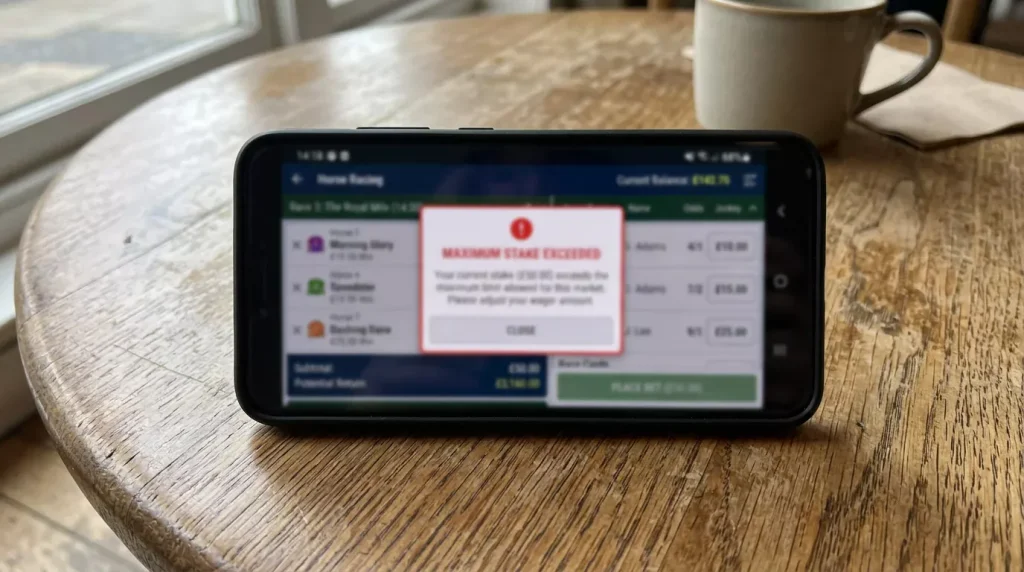
The email arrived at 7:14 on a Tuesday morning. “Following a review of your account, we have amended the maximum stake available to you on certain markets.” No explanation, no appeal process, no conversation. One day I was backing horses at £50 a time. The next, my maximum on any racing market was £1.87. Not £2. Not even a round number. £1.87 – as if the algorithm had calculated, to the penny, the largest stake at which I was no longer worth worrying about. Welcome to the world of restricted betting accounts, where being right is the fastest way to lose access to the market.
Restricted Betting Accounts — More on this topic at horse racing betting how to .
What Restriction Actually Looks Like
Restriction rarely arrives as an outright ban. Most bookmakers do not close winning accounts – they hollow them out. The maximum stake on your preferred markets drops to single-digit amounts that make serious betting impossible. Some operators apply the limit across all sports. Others target specific markets: you might still be able to stake £100 on a Premier League match but only £3 on a midweek handicap at Catterick, because that is where your edge was sharpest.
The process is sometimes called “gubbing” in punter slang, or being “factored down.” The operator assigns your account a risk factor that determines your available limits. A factor of 1.0 means full access. A factor of 0.1 means you are looking at 10% of normal stakes. Some operators go lower. The factor is invisible to you – there is no dashboard that shows your status – but the effect is unmistakable the moment you try to place a bet and the slip comes back with an amount that would not cover a round of drinks.
There is a broader context to understand here. The industry recorded 24.4 million active accounts and 34 million new registrations in the most recent reporting period, though new registrations fell 4.1% year-on-year. Bookmakers are not short of customers. Losing a few hundred winning accounts costs them nothing in volume terms and saves them real money in liability exposure. The maths is entirely rational from their side, which is what makes it so frustrating from yours.
The Bookmaker’s Rationale
Bookmakers are commercial businesses, not public utilities. They are under no obligation to accept your custom at stakes you find acceptable. Their profit model depends on a book of customers who, in aggregate, lose. A consistently profitable account is a cost centre, and the logical business response is to minimise the cost – either by restricting stakes so the account becomes functionally dormant, or by closing it altogether.
The triggers that get accounts flagged vary by operator, but the patterns are well known. Consistently beating the closing price – the final odds before the off – is the biggest red flag. If your bets routinely land at prices that are higher than the SP, the operator’s trading desk will notice within weeks. Betting early in the morning when markets are illiquid and prices are widest is another trigger, because early-morning value is where sharp money typically operates. Taking Best Odds Guaranteed repeatedly on horses that drift and then win at a bigger SP is a third – the promotion is designed for recreational punters, and heavy use by profitable accounts turns it from a marketing cost into a trading loss.
Overall betting turnover on British racing fell 4.3% in 2025 compared with 2024 and 10.3% against 2023. In a contracting market, bookmakers become more aggressive about protecting margin, which means the threshold for restriction drops. Accounts that might have flown under the radar in a booming market get flagged sooner when every percentage point of margin is contested.
Strategies For Staying Under The Radar
I should say upfront that no strategy guarantees immunity. Bookmakers have sophisticated tracking tools, and any consistently profitable pattern will eventually be detected. But there are behaviours that delay the inevitable.
Avoid consistently beating the morning price. If you identify value early, consider waiting until the market has moved closer to your assessment before placing the bet. You may sacrifice a point or two of price, but you avoid the most obvious trigger. Mix your betting across multiple operators rather than concentrating volume on one account – a £20 bet placed across four bookmakers attracts less attention than an £80 bet placed on one. Place some bets on markets you do not have an edge on – a football accumulator here, an ante-post selection there – to dilute the signal. Profitable racing bets embedded in a broader, less profitable betting profile look more like a recreational pattern than a sharp one.
None of this is gaming the system. It is adapting to the reality that bookmakers monitor accounts and make commercial decisions about who they want as customers. The punter who bets exclusively on value spots in midweek racing handicaps and nowhere else is painting a target on their account. The punter who bets on a spread of sports, markets, and bet types – with racing value hidden inside the noise – survives longer.
See also UK Horse Racing Betting Jargon .
The Exchange As An Alternative
Betting exchanges – where you bet against other punters rather than against a bookmaker – do not restrict winners in the same way. The exchange’s revenue comes from commission on winning bets, so a profitable customer is a profitable customer for the platform too. There is no adverse incentive to limit your stakes. You can back and lay at whatever amounts the market will absorb, and nobody emails you on a Tuesday morning to say your maximum is now £1.87.
The trade-off is liquidity. Exchange markets on UK racing are deep at the big meetings – Cheltenham, Ascot, the Guineas – but thin on midweek cards at smaller tracks. If your edge lives in Class 4 handicaps at Catterick on a Wednesday, the exchange might not have enough money in the market for you to bet at the size you want. You may also find that the price available on the exchange is tighter than the bookmaker would have offered before your restriction, because the exchange reflects genuine two-way money rather than a bookmaker’s tissue. For more on how exchanges differ from traditional operators, the exchange-versus-bookmaker comparison covers the structural differences in detail.
Is It Legal To Restrict An Account?
Yes. There is no UK law that compels a bookmaker to accept your bet at any particular stake or at all. The terms and conditions you agreed to when opening the account almost certainly include a clause allowing the operator to amend your betting limits at any time. The Gambling Commission has acknowledged the practice and has broadly defended the operators’ right to manage their commercial risk, though it has also expressed discomfort with the lack of transparency around how and why restrictions are applied.
There have been periodic calls – from punters, from racing bodies, from MPs – for legislation requiring bookmakers to accept bets up to a minimum stake, sometimes called a “right to bet.” Australia introduced a similar concept with its minimum bet rules. In the UK, no such legislation exists, and the current regulatory direction does not suggest it is imminent. The pragmatic response is to accept restriction as a structural feature of the market and plan accordingly: diversify accounts, use exchanges, and treat every bookmaker relationship as temporary.
Articles


Written by the editors at Furlongcraft.
