
UK Horse Racing Betting Jargon: A Working Glossary For The Pub, The Track And The App
 Available in US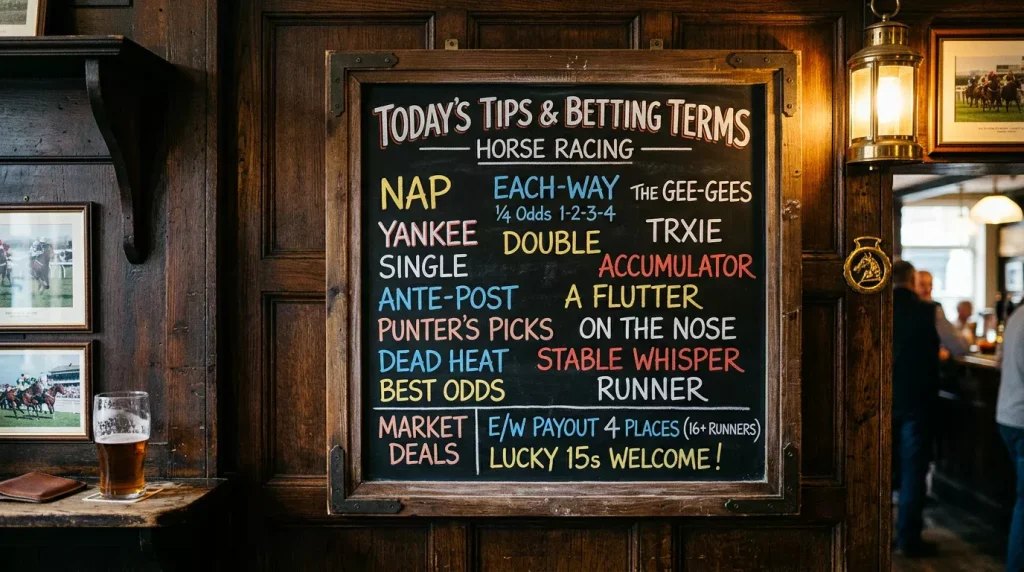
The first time someone in a betting shop told me they had “half a monkey each way on the springer,” I nodded as if I understood and then spent the walk home trying to work out what had happened. Horse racing in the UK carries a private language – part Cockney rhyming slang, part bookmaker shorthand, part centuries-old turf tradition – and it can make a newcomer feel like they have wandered into a conversation conducted entirely in code. This is not a dictionary. It is a working glossary of the terms you will actually hear at the track, in the pub, and on the forums, organised by the situations in which they come up.
UK Horse Racing Betting Jargon — More on this topic at horse racing betting how to .
Money And Stakes Slang
Racing’s money slang is borrowed from the broader world of British betting and cash culture, but certain terms survive in the ring and the shop long after they have disappeared from everyday speech. A “pony” is £25. A “ton” is £100. A “monkey” is £500. A “grand” is £1,000 – that one has crossed into mainstream use, but it started in the betting world. A “carpet” is £3 or, in older usage, 3/1, though you hear it less now than you did a decade ago.
When someone says they are having a “score” on a horse, they mean £20. A “nifty” is £50, though regional variation means you will also hear “half a ton” for the same amount. “Bottle” is 2/1 in odds – from Cockney rhyming slang via “bottle of glue” = two. “Burlington Bertie” is 100/30, or roughly 10/3 – a leftover from the music hall era that somehow refuses to die. These terms are less about precision and more about fluency. You do not need them to place a bet, but you need them to follow a conversation in the Tatts ring without looking lost.
Andrew Rhodes, the Gambling Commission’s Chief Executive, has observed that online betting follows the pattern of large marquee events, with participation spiking around festivals and flagship races. At those events – Cheltenham, Aintree, Royal Ascot – the money slang is at its densest because the ring attracts punters who grew up with it. An estimated 22.5 million UK adults bet at least monthly, but only a fraction use this vocabulary daily. It is a subset language, alive and kicking at the point where cash meets confidence.
Market Movement Terms
The language of how a horse’s price changes tells you almost as much as the price itself. A “drifter” is a horse whose odds are getting longer – moving from 5/1 to 7/1, say – usually because money is not coming for it. A “steamer” is the opposite: a horse being heavily backed, its price shortening rapidly as money pours in. If someone says “it’s been steaming all morning,” they mean the price has contracted significantly since the market opened.
A “springer” is a horse whose price collapses dramatically in a short period, often on the back of inside information or a well-organised gamble. The term implies something more deliberate than a steamer – a springer does not just attract money, it arrives in the market as if someone had planned the move. A “plunge” is the extreme version: a co-ordinated betting coup where a horse’s price goes from 20/1 to 5/1 in minutes because connections have placed large bets simultaneously across multiple operators.
When a horse “firms up,” its price shortens. When it “eases,” the price drifts. “On the drift” and “on the move” describe sustained directional shifts rather than one-off ticks. Bookmakers in the ring describe a horse as “a false price” when they believe the market is wrong – the horse is too short or too long relative to its actual chance. This is not altruism. It is a bookmaker signalling that they are happy to lay the horse at its current price because they think they are on the right side of it.
Race-Day Jargon
At the track, certain terms describe the practical business of watching and betting on races. The “card” is the day’s programme of races – “a six-race card” means six races scheduled. The “off” is the start time. “Going to post” means the horses are walking to the starting point. “Under orders” means the starter has called the jockeys to attention and the race is about to begin. Once they are under orders, most bookmakers close their books and no further bets are accepted.
A “non-runner” is a horse withdrawn before the race. An “objection” is a formal complaint by a jockey after the race, claiming interference. A “stewards’ enquiry” is an investigation by the race officials, usually into possible interference or a riding offence. “Weighed in” is the announcement that all jockeys have weighed in correctly after the race and the result stands – crucially, bookmakers do not pay out until “weighed in” is confirmed.
In the paddock, you might hear someone describe a horse as looking “well” – bright-coated, alert, muscled – or “washy” – sweating excessively, usually a sign of anxiety. “On their toes” means the horse is keen, pulling the handler, which might suggest fitness or might suggest a temperament problem depending on context. “Colty” describes a male horse behaving immaturely – looking at other horses, not concentrating – and is a warning sign for punters who watch the pre-parade.
Bookmaker-Side Jargon
Bookmakers have their own vocabulary that leaks into public discourse. A “tissue” is the bookmaker’s initial set of odds, compiled before the market opens – the raw assessment of each horse’s chance before money starts talking. “Overround” is the margin built into the book, ensuring the percentages add up to more than 100%. A “balanced book” means the bookmaker has laid the field in such a way that they profit regardless of the winner, though in practice this is rare because it requires constant adjustment.
“Liability” is the maximum a bookmaker stands to lose on a particular runner. When a bookmaker says “I’m short of that one,” they mean they have taken too much money on it and would lose heavily if it wins. “Laying off” is the practice of placing a bet with another bookmaker to reduce exposure. On-course bookmakers do this constantly, using runners to transmit bets to the rails layers. About 13% of the UK population visits a betting shop at least once a month, but the language of the ring and the shop is increasingly niche – understood by regulars, baffling to newcomers, and slowly migrating online where it gets flattened into standardised app interfaces.
See also How To Read Horse Racing Odds In The UK .
Terms Worth Being Careful With
Some racing slang carries connotations that are not immediately obvious. “Punter” itself is a word with two registers. In racing culture it is affectionate and self-applied – punters call themselves punters with pride. In broader British English it can mean “customer” in a mildly dismissive way, or even “mark” – someone being sold to. Context matters. At the track, “I’m just a punter” is honest and self-deprecating. In a boardroom, “the punters won’t notice” is condescending.
“Coup” and “sting” both describe organised betting gambits, but they carry different weight. A coup is generally admired – a well-executed plan that beat the market fairly. A sting implies something closer to deception, though the line between the two is debated endlessly in racing circles. “Ringer” is unambiguous: a horse substituted for another, which is criminal fraud. Using the term casually to describe a horse that has improved dramatically is inaccurate and potentially offensive to connections.
If you are new to racing, the best approach is to listen before you speak. Spend an afternoon in the ring at a mid-tier meeting – somewhere like Newbury or Haydock – and tune into the language around you. Within an hour you will have absorbed more terminology than any glossary can teach, and you will know which terms sit naturally in your mouth and which ones do not. Racing jargon is not about showing off. It is about belonging to a conversation that has been running, in one form or another, for 300 years.
Articles

Created by the "Furlongcraft" editorial team.
