
Reading A UK Racecard: Every Number, Letter And Symbol Translated
 Available in US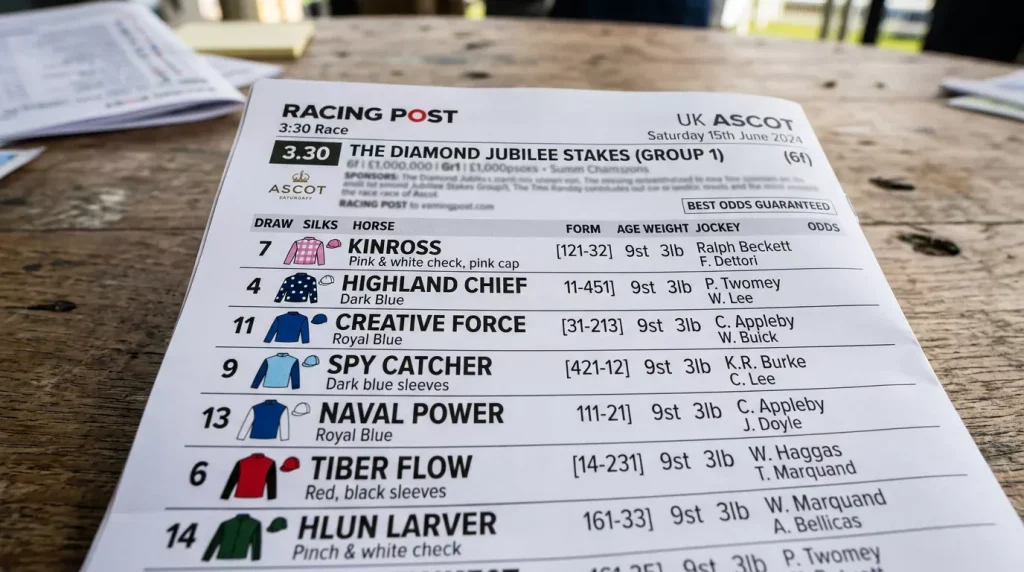
The Alphabet Soup That Decides Your Bet
The first time I opened a Racing Post racecard, I genuinely thought it was written in code. Numbers crammed next to letters, tiny superscript symbols, abbreviations that meant nothing to me, and a grid of data that looked more like a spreadsheet than a guide to picking horses. It took me months to read one fluently, and six years later I still occasionally check what a particular headgear code means. The racecard is the single most information-dense document in horse racing, and learning to read it is the difference between betting on data and betting on names.
British racecards follow a standardised layout, but the amount of information packed into each line is staggering. The BHA has noted that the horse population continues to decline and the betting environment remains challenging – which makes every piece of racecard data more valuable, because smaller fields and tighter markets leave less room for error.
Reading A UK Racecard — More on this topic at horse racing betting how to .
Anatomy Of A Racecard
Every racecard entry follows the same structure, though the visual layout differs between newspapers, websites, and apps. The core elements, reading roughly left to right, are: cloth number and draw, form figures, horse name with age and headgear, weight carried, jockey, trainer, and odds.
The cloth number is the number the horse wears on the raceday. The draw – shown in brackets in Flat races – is the starting stall position, and it matters enormously on certain tracks. Form figures are the compressed history of the horse’s recent runs, reading right to left with the most recent run last. The horse’s name is sometimes followed by age, sex, and breeding details. Weight is the total carried, including the jockey, and it is given in stones and pounds.
Below or beside the main line, you will often find additional information: the horse’s official rating (OR), the trainer’s recent form percentage, the jockey’s course record, the owner’s silks description, and sometimes speed figures or Racing Post Ratings (RPR). Not all of this appears on every racecard – the Racing Post offers the most detailed version, while bookmaker apps often strip it back to essentials.
Think of the racecard as a CV for each horse. Every piece of information answers a question: how has this horse performed recently? How much weight is it carrying? Who is training and riding it? Where in the stalls does it start? The skill is not in reading each element individually – it is in combining them into a judgement.
Form Figures
Form figures are the racecard’s most compressed data. They look something like this: 2311-45. Each digit represents the finishing position in a race, reading left to right from oldest to most recent. A hyphen indicates a break between seasons. So 2311-45 tells you: the horse finished second, third, first, first last season, then fourth and fifth this season.
Letters carry specific meanings. “F” means the horse fell. “U” means it unseated the jockey. “P” means it was pulled up – the jockey stopped riding, usually because the horse was struggling. “R” means refused. “B” means brought down by another horse’s fall. “S” means slipped up. “C” means carried out. “O” means ran out.
A “0” indicates the horse finished outside the first nine. A dash at the beginning of the sequence means the horse has not raced in a while. Form figures from the previous season are separated from the current season by a hyphen, so you can see at a glance whether a horse is coming off recent activity or returning from a layoff.
The form sequence is typically six runs deep, though some racecards show more. Recent form is more predictive than distant form in almost all cases, so the rightmost figures carry more weight. A horse showing 111 on the right is in the form of its life. A horse showing P0U on the right has had three bad runs in a row – and that sequence should trigger serious caution.
Headgear And Equipment
Headgear codes appear next to or below the horse’s name and signal the use of equipment designed to aid concentration or breathing. The most common codes are: “b” for blinkers, “v” for visor, “h” for hood, “t” for tongue-tie, “e/s” for eye-shields, and “p” for cheekpieces.
Blinkers block a horse’s peripheral vision, forcing it to focus forward. Visors do the same but with a small slit, allowing partial side vision. Hoods cover the ears and head to calm a nervous horse. Tongue-ties prevent the tongue from obstructing the airway during exertion. Each piece of equipment tells a story about the horse’s temperament or physical tendencies.
The really useful indicator is when headgear appears for the first time. A small “1” or an asterisk next to the headgear code means it is being applied for the first time. First-time blinkers, in particular, are a well-known form factor – some horses respond dramatically to blinkers, running with renewed focus. Others are unaffected. The statistics on first-time headgear are mixed enough that it should not be your sole reason to back a horse, but it is worth noting when combined with other positive signals.
Weight And Draw
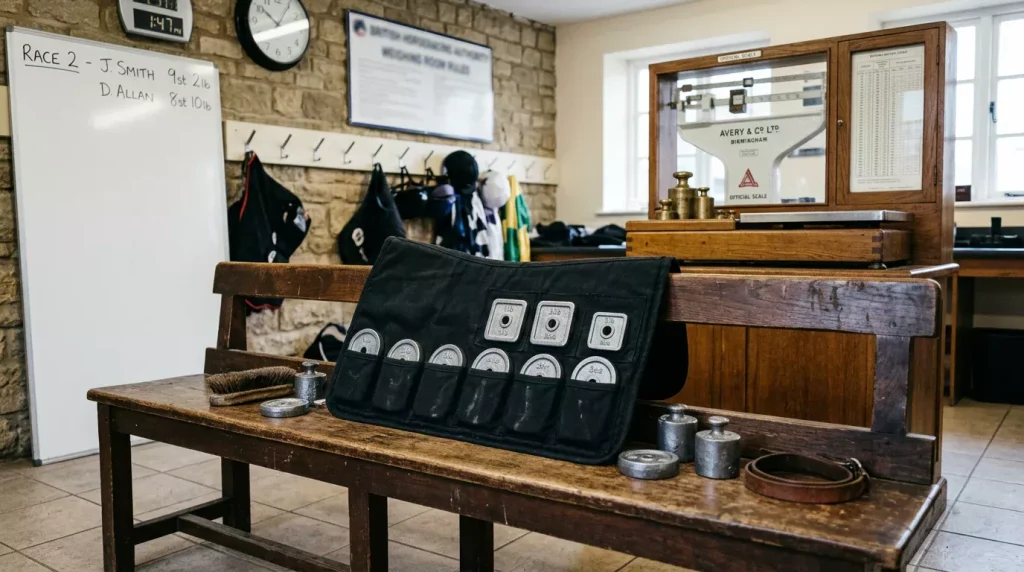
Weight is given in stones and pounds. In handicap races, each horse carries a different weight calculated by the BHA’s handicapper based on official rating. In non-handicap races, weight is determined by age and sex allowances. A horse’s weight relative to the rest of the field tells you how the handicapper rates it against its rivals.
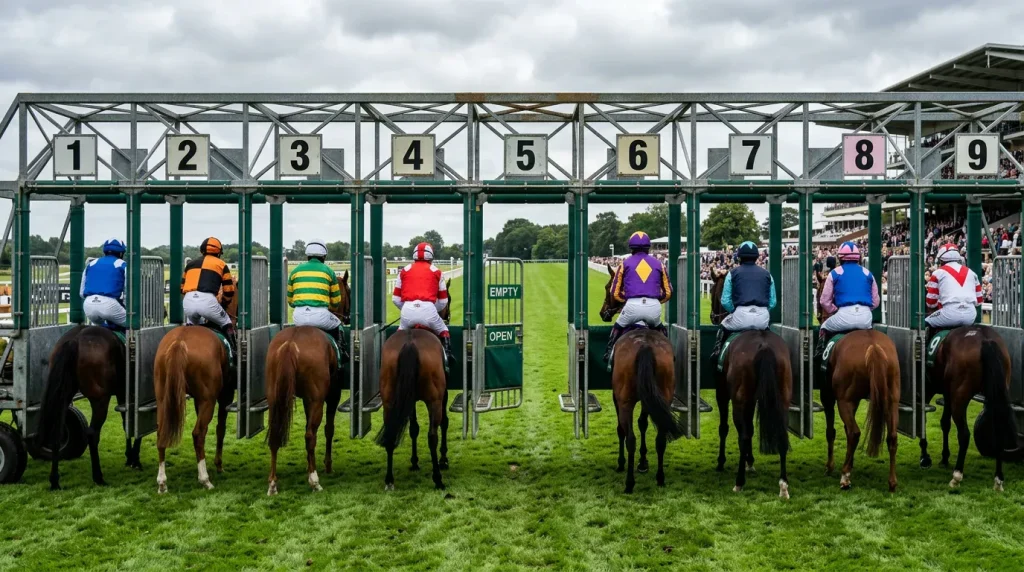
The draw – the starting stall position in Flat races – is one of the most underappreciated data points on the racecard. On some tracks, the draw has a significant impact on outcome. At Chester, low draws on the inside rail are a massive advantage. At Beverley, high draws are favoured. At York, the bias depends on the going and the distance.
Flat field sizes in 2025 averaged 8.9 runners, down from 9.14 in 2024, while jumps fields averaged 7.84 against 8.49 the year before. Smaller fields reduce the draw’s influence in some cases, but on sharp, turning tracks, even an 8-runner race can show a clear draw bias. BHA modelling projects that runs on British racecourses will decline a further 6-7% between 2024 and 2027 – meaning draw knowledge on the remaining fields becomes more, not less, relevant.
See also Studying Form In UK Racing .
The Trainer-Jockey Line
Below the horse’s main entry, the racecard lists the trainer and jockey. Both pieces of information carry predictive value, but in different ways.
The trainer’s strike rate – the percentage of runners who win – is a headline figure, but it needs context. A trainer with a 15% strike rate in Class 1 races is performing well. The same percentage in Class 6 races is less impressive. Look at the trainer’s form at this specific course, at this class level, and with this type of horse. A National Hunt trainer sending a runner to a Flat meeting, or a predominantly Flat yard entering a novice chase, is often a weak signal.
The jockey tells you about intent. Top jockeys have limited rides available and choose carefully. If a leading jockey picks up a ride for a smaller yard at a midweek meeting, that booking suggests the horse has been working well at home. Jockey changes are equally informative: if a retained jockey is replaced by a claiming apprentice, the yard may be prioritising a weight allowance over riding skill, which tells you something about the horse’s expected competitiveness.
The trainer-jockey combination is especially useful when the pairing is unusual. A top trainer booking a top freelance jockey for a low-key race at a minor track is a signal worth noticing. It does not guarantee success, but it suggests confidence – and confidence at that level is rarely misplaced. Understanding these signals is the first step toward a deeper form study process.
Articles

Written by the editors at Furlongcraft.
