
Ante-Post Betting Explained: Locking In Price Before The Field Forms
 Available in US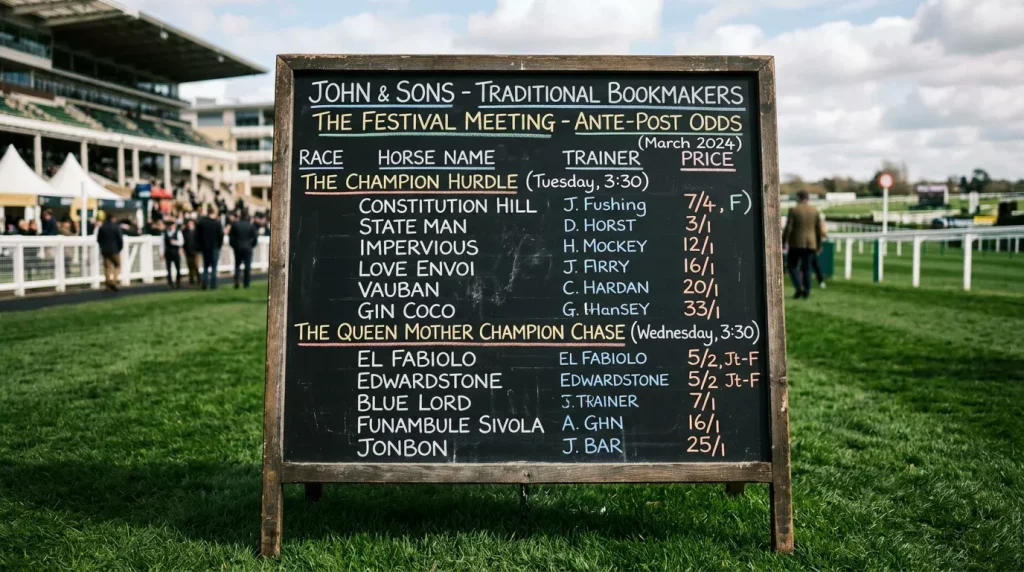
The Price I Took Six Weeks Early
Six weeks before the Cheltenham Gold Cup in 2024, I backed a horse at 10/1 in the ante-post market. By race day, the same horse was 4/1. I collected at 10/1 because ante-post means your price is locked the moment you place the bet. That difference – 10/1 versus 4/1 – is the entire argument for futures betting in horse racing. It is also the reason you occasionally lose your entire stake on a horse that never even makes it to the start line.
Ante-post betting is the practice of backing a horse well in advance of a race, sometimes weeks or months before the event. The prices are bigger because the uncertainty is greater, but the trade-off is severe: if your horse does not run, your stake is gone. No refund, no consolation. That asymmetry is what separates ante-post from every other form of horse racing bet.
Ante-Post Betting Explained — More on this topic at horse racing betting how to .
What Ante-Post Means
The term comes from Latin – “ante” meaning before, “post” meaning the starting post. In practice, it refers to any bet placed before the day of the race, though the precise cut-off varies by bookmaker and by event. For major festivals, ante-post markets open months in advance. For a midweek handicap at Wolverhampton, there is no ante-post market at all.
The defining feature is the absence of “non-runner, no bet” protection. When you bet on race day – or in many cases from the morning of the race once final declarations are confirmed – your stake is returned if your horse is withdrawn. Ante-post bets carry no such safety net. The bookmaker prices the market with withdrawal risk factored in, which is precisely why ante-post prices are longer than day-of-race prices.
Betting turnover on British racing fell 4.3% in 2025 versus 2024 and 10.3% versus 2023. Against that backdrop, ante-post markets on major festivals have held up relatively well because they attract a different type of punter – one willing to commit capital early for the reward of a better price. The BHA noted that turnover on premier fixtures remained flat while core fixtures dropped 14.4% year-on-year in the first quarter of 2025, a split that tracks neatly with where ante-post interest concentrates.
Why Prices Are Bigger
I once asked a senior odds compiler why ante-post prices could be so generous compared with what appears on the morning of the race. The answer was disarmingly simple: “We are pricing the field that might run, not the field that will run.”
When a bookmaker opens an ante-post market for the Champion Hurdle six months out, they might price 30 or 40 potential runners. By declaration stage, the field might be 12. All those non-runners compress the market. Money that was spread across 40 prices now concentrates on 12, and each surviving horse shortens. The punter who took 10/1 six months ago is holding a ticket on a horse that is now 5/1 or shorter.
There is another factor: information asymmetry. Six months out, trainers, owners and bookmakers all have incomplete data. A horse might have a niggling injury that never becomes public. A planned race campaign might change. The going at the track on race day is unknowable months in advance. All of this uncertainty inflates the price, and the bookmaker is comfortable offering it because a percentage of ante-post stakes will be lost to non-runners without any race needing to be run.
The bigger price is real value – but only if the horse runs. That conditionality is everything.
The Non-Runner Rule
This is where ante-post betting gets painful. A friend of mine backed a horse for the Grand National at 20/1 in January. The horse picked up a tendon injury in February and was ruled out for the season. Stake gone. No refund. He had known the rule, accepted the risk, and was still furious when it happened. Knowing a rule intellectually and feeling it in your pocket are different things.
Under standard ante-post terms, if your horse does not run for any reason – injury, change of plan, the trainer decides the ground is wrong, the owner sells the horse – your bet is a loser. The bookmaker does not care why the horse did not run. The terms are clear: no run, no refund.
This rule exists because without it, ante-post markets could not function. If every non-runner triggered a refund, bookmakers would shorten every ante-post price to account for the withdrawal risk they would be absorbing. The longer prices exist precisely because the punter carries the non-runner risk. You are being paid for that risk in the form of a better price. Whether that payment is adequate depends on the specific horse, the specific race, and how far out you are betting.
As a rough guide, the further from the race you bet, the higher the non-runner risk. A bet placed six months before Cheltenham carries more withdrawal exposure than one placed two weeks before. The price difference between those two moments should reflect that gap – and often it does, but not always proportionally.
NRNB Promotions
Non-runner, no bet – NRNB – is a promotional overlay that some bookmakers apply to selected ante-post markets. Under NRNB terms, if your horse is withdrawn, your stake is returned as cash or a free bet. This effectively removes the biggest downside of ante-post betting while preserving most of the upside.
The catch is predictable: NRNB prices are shorter than standard ante-post prices. The bookmaker reprices the market to absorb the refund risk. If a horse is 10/1 ante-post under standard terms, the NRNB price might be 7/1 or 8/1. You are buying insurance, and insurance has a cost.
NRNB promotions tend to appear on the biggest races – the Grand National, Cheltenham Festival, Royal Ascot – where the bookmaker wants to attract volume and is willing to accept the refund liability. On smaller races, NRNB is rare. Whether the reduced price is worth the protection depends on how you assess the specific horse’s likelihood of making the race. A horse with a clean bill of health from a yard known for meticulous planning is lower-risk than a fragile jumper with a history of setbacks. NRNB is most valuable when applied to horses you are least sure will run – which, ironically, are the horses most likely to be withdrawn.
See also Starting Price Explained .
When Ante-Post Pays Off
The case for ante-post betting is strongest in three scenarios. First, when you have a genuine informational edge – a horse that you believe the wider market is underpricing because public attention has not yet caught up with its form trajectory. This is rare but real, particularly with unexposed types early in a National Hunt season.
Second, when the price contraction between now and race day is likely to be significant. If a horse is 12/1 in November for a race in March, and you expect it to be 5/1 by declaration day based on its likely prep-race results, the ante-post price is offering value even after accounting for non-runner risk. You do not need to be right every time; you need the average price advantage to outweigh the stakes lost to withdrawals over a large enough sample.
Third, when the non-runner risk is genuinely low. A horse with a clean veterinary record, a trainer who rarely changes plans, and a race that suits the horse’s profile on any likely going – that combination reduces withdrawal probability to a level where the ante-post price becomes a bargain rather than a gamble.
The worst ante-post bets are the ones placed on impulse after a single impressive performance, months before a target race, on a horse with a known physical vulnerability. Every year, the ante-post graveyard fills with these bets. The price looked attractive because the risk was real, and the risk materialised.
Articles




Published by the Furlongcraft team.
