
Value Betting On UK Horse Racing: Pricing The Race Before The Bookmaker Does
 Available in US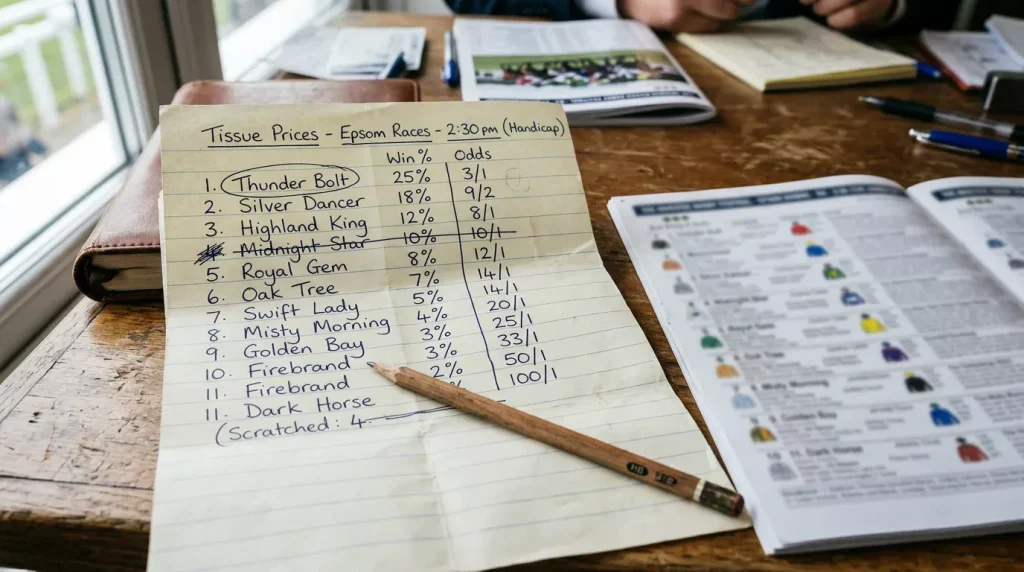
I backed a 14/1 shot at Haydock once that I genuinely believed was a 6/1 chance. It finished fourth. I was still pleased with the bet. That sentence confuses people who think betting is about picking winners, but it makes perfect sense if you think about betting as pricing. Value is not about what wins – it is about what the price should be. If the true probability of a horse winning is higher than the price implies, the bet has value regardless of the result. Finding those gaps consistently is the closest thing horse racing offers to a genuine edge.
Value Betting On UK Horse Racing — More on this topic at horse racing betting how to .
What Value Actually Means In A Betting Market
Every price a bookmaker offers implies a probability. A horse at 4/1 is being priced at a 20% chance of winning. If you believe, after studying the form, the going, the draw, the jockey booking, and the class of the race, that the horse actually has a 28% chance, the price is bigger than it should be. That difference – your estimated probability minus the implied probability – is the overlay. A positive overlay means value. A negative overlay means you are paying too much.
This is not abstract theory. It is the foundation of every profitable approach to horse racing that has ever survived long-term scrutiny. The bookmaker builds an overround into the market – a margin that ensures the combined implied probabilities exceed 100%. A typical six-runner race might price up at 115%, meaning the bookmaker expects to keep roughly 13% of turnover as margin. Your job as a value bettor is to identify individual horses within that market where the bookmaker’s margin has created a price that is wider than the true chance warrants.
It helps to understand the broader market context. Betting turnover on British racing fell 4.3% in 2025 versus 2024, and 10.3% against 2023. In Q1 2025, turnover on core fixtures dropped 14.4% year-on-year, while premier fixtures held steady. That divergence matters because core fixtures – the midweek cards, the smaller meetings – attract less analytical attention and less money, which means their prices are often less efficient. The value bettor’s natural hunting ground is not the Cheltenham Gold Cup but the Tuesday handicap at Catterick.
Building Your Own Tissue Price
A tissue price is a bookmaker’s initial set of odds for a race, compiled before the market opens. You can build your own version – a personal tissue – using publicly available information. The process is simpler than it sounds, though it requires practice to do well.
Start with the official ratings. Every horse in a handicap carries a BHA rating that reflects its assessed ability. In a Class 4 handicap, you might have horses rated between 65 and 80. The handicapper has already done the heavy lifting by assigning weights to equalise chances, but ratings are backward-looking. They reflect what a horse has done, not what it might do today given the specific conditions. Your tissue adjusts the ratings for factors the handicapper cannot easily capture: how a horse handles today’s going, whether the draw position helps or hurts on this particular course, the jockey’s recent form, the trainer’s strike rate at this track, and how the pace of the race is likely to unfold.
Assign each horse a percentage chance of winning based on your adjusted assessment. Make sure the percentages sum to 100% – if they do not, you are either overestimating or underestimating the field. Convert those percentages to odds. If you think a horse has a 16% chance, that is roughly 5/1. If the bookmaker is offering 8/1, you have found a potential overlay. If the bookmaker offers 3/1, the horse is poor value no matter how much you fancy it.
I keep my tissues in a simple spreadsheet: one column for the runner, one for my estimated probability, one for the equivalent decimal odds, and one for the bookmaker’s actual odds at the time I check. The fourth column highlights overlays automatically. Over six years of doing this, I have found that my tissue is reasonably accurate on turf handicaps at tracks I know well, and significantly less accurate on races I have not studied carefully. Consistency of process matters more than brilliance of insight.
Spotting Overlays In Practice
An overlay is not always obvious. Sometimes it is a horse returning from a break whose recent work has been strong but whose market price reflects only the absence from the racecourse. Sometimes it is a horse dropping in class after a respectable run at a higher level – the form figures show a string of midfield finishes, but those finishes came against better opposition, and the market has not fully credited the class drop.
Market movements can also signal overlays. If a horse opens at 10/1 in the morning and drifts to 14/1 by the off without any obvious negative – no jockey change, no change of going, no poor paddock report – the drift might reflect a lack of money rather than a lack of ability. The absence of support is not evidence of inability. Conversely, a horse that shortens from 8/1 to 4/1 may have been correctly priced at 8/1 by your tissue, and the shortening has destroyed the value. Following money blindly is not the same as finding value – it is just following money.
One discipline I have forced on myself is never betting a race where I have not built a tissue first. If I have not done the work, I have no framework for judging whether a price is fair. Gut feeling is not a method. Gut feeling backed by a tissue is a method with a reality check.
Discipline Over Noise
The hardest part of value betting is not the analysis – it is the patience. You will watch value bets lose. Regularly. A horse you correctly assessed at 25% will fail to win three times out of four. That is what 25% means. The temptation after a string of losing value bets is to abandon the approach and start backing shorter-priced horses that feel “safer.” But shorter prices in a market with a 15% overround are almost never value. You are paying a premium for the illusion of certainty.
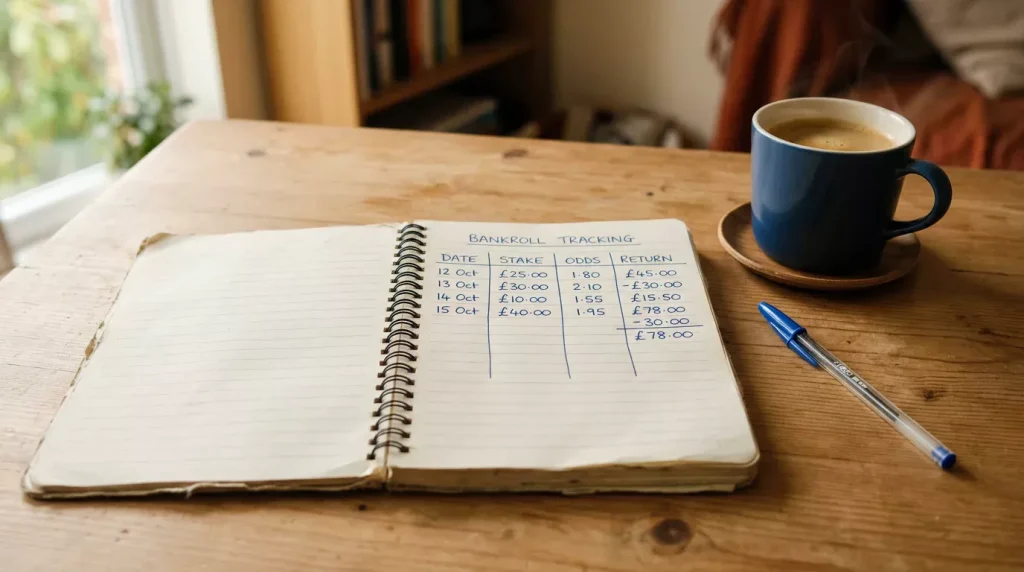
I track my bets in rolling blocks of 100. Below that sample, individual results are meaningless noise. Above it, patterns start to emerge. After 100 bets I can see whether my strike rate at various odds ranges matches my tissue predictions. If I am pricing horses at 20% and winning 22% of the time in that band, the method is working. If I am pricing at 20% and winning 12%, something in my process is broken and needs fixing. Without the record, I would never know which of those two realities I was living in.
See also Are UK Betting Shops Still Relevant? A 2026 Reality Check For Racing… .
Keeping A Value-Betting Record
Every value bet I place goes into the same spreadsheet with the same columns: date, course, race time, horse, my tissue odds, the actual odds taken, stake, and result. At the end of each month I calculate three numbers – strike rate, return on investment, and the average overlay I captured. The overlay column is the one most people neglect. It tells me whether I am consistently finding prices bigger than my assessments, or whether I am drifting into bets where the overlay is marginal and the margin for error is thin.
A positive ROI over 300 or more bets at an average overlay of two or more percentage points is the signal that the approach has genuine substance. Anything less and I cannot separate skill from luck. That sounds like a lot of bets – and it is. Value betting is not a weekend project. It is a long-term discipline that rewards patience, punishes shortcuts, and treats every race as a data point rather than a drama.
Articles

Written by the editors at Furlongcraft.
