
How To Read Horse Racing Odds In The UK: Fractions, Probability And Value
 Available in US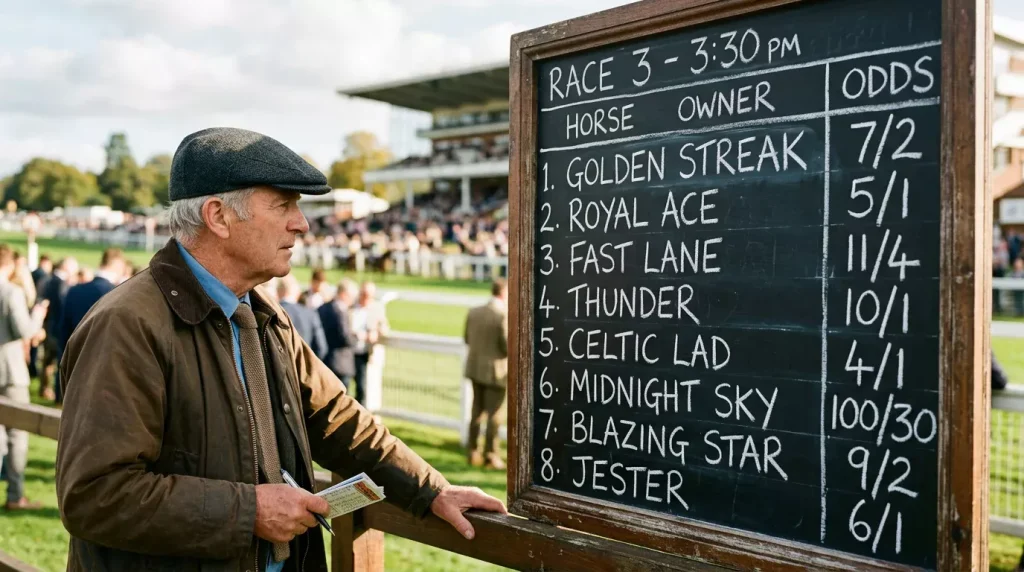
I lost my first ever horse racing bet because I misread the odds. Stood at Newbury with a crumpled betting slip, convinced that 11/4 meant the horse had to finish in the top four. It did finish fourth, as it happened — and I still lost, because 11/4 is simply a price, not a placement. That afternoon cost me twelve quid and a fair bit of dignity, but it taught me something most guides skip over entirely: before you worry about form, trainers, or ground conditions, you need to understand what the numbers on the board are actually telling you.
UK horse racing runs almost exclusively on fractional odds — a format that looks intimidating until you realise it follows one consistent rule. Every fraction is a ratio of profit to stake: how much you stand to gain for every pound you risk. Once that clicks, the rest — decimals, implied probability, overround, value — falls into place like tumblers in a lock. This guide walks through the entire chain, from reading a simple fraction to spotting when a bookmaker’s price is genuinely wrong. No jargon without context, no maths without a worked example, and nothing that assumes you already know what you are doing.
How To Read Horse Racing Odds In The UK — More on this topic at horse racing betting how to .
Why The UK Still Uses Fractional Odds
Walk into any betting shop in Britain and the screens will show 5/1, 7/2, 11/8. Cross the Channel to France or open a European exchange and you will see 6.00, 4.50, 2.38. Same horses, same races, different notation. Most of continental Europe and virtually all betting exchanges default to decimal odds. The UK stubbornly clings to fractions — and there is a reason worth understanding, because it shapes how prices move and how bookmakers communicate with the market.
Fractional odds predate electronic displays, algorithms, and even telephones. They emerged from the Tattersalls betting ring, where on-course bookmakers chalked prices on boards and needed a format that communicated profit instantly. A punter glancing at 4/1 knows at once: four pounds profit for every one pound staked. No mental arithmetic, no decimal points, no ambiguity. That speed mattered when bets were struck face-to-face in a crowd, and it still matters today when scanning a racecard on your phone ten minutes before the off.
The cultural weight of fractions goes deeper than convenience. Racing commentary, newspaper tipsters, and pub conversations all run on fractional language. A horse “drifts from 3/1 to 9/2” tells an experienced punter that confidence is draining — money is leaving the horse. A horse “comes in from 5/1 to 7/2” signals a market move backed by real cash. Decimals convey the same information mathematically, but they lack the narrative shorthand that fractions carry. That shorthand is the reason you will not find a Racing Post column quoting odds of 3.50. It would feel like reading Shakespeare translated into spreadsheet cells.
None of this means decimals are inferior. For calculating returns on multiples or comparing prices across bookmakers, decimals are faster and cleaner. Most UK betting apps let you toggle between formats in settings, and I would encourage anyone new to racing to try decimals for a week, then switch back. You will appreciate fractions more once you have seen the same information expressed both ways. But in every section that follows, I will use fractions first, because that is what you will see at any UK racecourse, in any British betting shop, and on any default-setting UK app.
Reading The Fraction: What The Numbers Actually Say
Every fractional odd follows one pattern: profit / stake. The number on the left is what you win; the number on the right is what you risk. At 5/1, you win five pounds for every one you put down. At 1/5, you win one pound for every five you stake. That single rule covers every fraction you will ever encounter, from 100/1 outsiders to 1/10 stone-cold favourites.
Where newcomers stumble is with fractions that do not sit neatly on whole numbers. Take 11/4 — the price that caught me out at Newbury. Split the fraction: eleven divided by four is 2.75. That means for every four pounds staked, the profit is eleven. Or per pound: £2.75 profit, plus your £1 stake back, giving a total return of £3.75 per pound. A £10 bet at 11/4 returns £37.50 — twenty-seven pounds fifty in profit plus the original tenner.
Some fractions are so common they have names. Evens, written as 1/1 or sometimes just “EVS” on the board, means your profit equals your stake exactly: risk ten, win ten, collect twenty. Odds-on prices — anything where the right-hand number is bigger than the left, like 4/6 or 2/5 — mean you are risking more than you stand to gain. A horse at 4/6 requires you to stake six pounds to win four. The total return on a £6 bet is £10, which sounds fine until you realise you needed a favourite to win just to make four quid.
Then there are the shorthand fractions the market uses constantly: 6/4 (sometimes written as “six to four on”), 5/2, 9/4, 100/30. These look random until you understand that bookmakers price in established increments. The standard ladder runs 1/5, 2/9, 1/4, 2/7, 3/10, 1/3, 4/11, 2/5, 4/9, 1/2, 8/13, 4/5, 5/6, 10/11, EVS, 11/10, 6/5, 5/4, 11/8, 6/4, 13/8, 7/4, 15/8, 2/1, 9/4, 5/2, 11/4, 3/1, 100/30, 7/2, 4/1 and upwards. You do not need to memorise the full ladder, but knowing it exists explains why you will never see a price like 3.7/1 — it does not exist in the fractional system.
The quickest mental check when reading any fraction: if the left number is bigger, you stand to profit more than you risk. If the right number is bigger, you are laying out more than you will win. Equal numbers, even money. That is all you need to navigate a racecard.
See also Horse Racing Bet Types Explained .
Converting Fractional Odds To Decimal
A friend of mine switched to decimal odds after one too many miscalculated accumulators. He had been multiplying fractions by hand on the back of a Racing Post, getting different totals each time, and finally accepted that decimals exist for a reason. The conversion is straightforward, and once you have done it a dozen times, it becomes automatic.
Divide the left number by the right number, then add one. That is the decimal equivalent. At 5/1: five divided by one is five, plus one equals 6.00. At 11/4: eleven divided by four is 2.75, plus one equals 3.75. At 4/6: four divided by six is 0.667, plus one equals 1.667. The “plus one” accounts for your original stake being returned alongside the profit — decimals always include the stake in the quoted price, while fractions quote profit only.
This distinction trips up people moving between formats. A decimal price of 3.00 does not mean three pounds profit per pound staked — it means three pounds total return, which is two pounds profit plus one pound stake. The fractional equivalent is 2/1. Always subtract one from a decimal to find the profit multiple.
Here are some common conversions worth knowing by heart:
| Fractional | Decimal | £10 Stake Returns |
|---|---|---|
| 1/5 | 1.20 | £12.00 |
| 1/2 | 1.50 | £15.00 |
| EVS (1/1) | 2.00 | £20.00 |
| 6/4 | 2.50 | £25.00 |
| 5/2 | 3.50 | £35.00 |
| 4/1 | 5.00 | £50.00 |
| 10/1 | 11.00 | £110.00 |
| 33/1 | 34.00 | £340.00 |
If you are comparing prices across multiple bookmakers — and you should be — decimals are faster because they let you see the total return without intermediate arithmetic. A horse at 3.75 on one site versus 3.50 on another tells you instantly which pays more. In fractions, 11/4 versus 5/2 requires a mental conversion step to see the gap. For single bets, that extra step is trivial. For a four-fold accumulator, it is the difference between getting the maths right and getting it wrong.
Implied Probability: Turning Odds Into A Percentage
This is where odds stop being just prices and start being arguments. Every set of odds implies a probability — a claim by the bookmaker about how likely a horse is to win. Understanding that claim is the single most important skill in betting, because it is the foundation of finding value.
The formula is simple: take the denominator (right-hand number), divide it by the sum of both numbers, and multiply by 100. For a horse at 4/1: 1 divided by (4 + 1) = 0.20, or 20%. The bookmaker is saying, in effect, this horse has a 20% chance of winning. At EVS (1/1): 1 divided by 2 = 50%. At 1/4: 4 divided by 5 = 80%. At 10/1: 1 divided by 11 = 9.1%.
If you prefer working from decimals, the calculation is even simpler: divide 1 by the decimal price, then multiply by 100. A horse at 5.00 decimal: 1 / 5.00 = 0.20, or 20%. Same answer, fewer steps.
Why does this matter? Because your own assessment of a horse’s chance is a percentage too — even if you have never articulated it that way. When you look at a race and think “that horse has a decent chance, maybe one in three”, you are assigning roughly a 33% probability. If the bookmaker is offering 4/1, the implied probability is 20%. Your estimate is higher than the bookmaker’s. In theory, that is a value bet — you believe the horse wins more often than the price suggests.
Implied probability also strips away the emotional noise of big numbers. A horse at 33/1 sounds thrilling — thirty-three times your money back. But the implied probability is just 2.9%. That means the bookmaker expects it to lose roughly 97 times out of 100. If you think the real chance is closer to 5%, then 33/1 is genuine value despite the long odds. If you are betting because 33/1 “sounds exciting”, you are not finding value — you are buying a lottery ticket.
The catch, of course, is that bookmakers do not price races at true probability. They build in a margin. And that margin is where the next section starts.
The Overround And The Bookmaker’s Margin
If you add up the implied probabilities of every horse in a race, the total should equal 100% — in a fair market. It never does. In practice, the total comes out somewhere between 110% and 140%, depending on the race, the bookmaker, and the number of runners. That excess is called the overround, and it is the mathematical guarantee that the bookmaker makes money in the long run.
Here is a concrete example. Suppose a six-runner race is priced at 2/1, 3/1, 5/1, 8/1, 12/1, and 16/1. The implied probabilities are 33.3%, 25%, 16.7%, 11.1%, 7.7%, and 5.9%. Add them up: 99.7%. That would be an almost perfectly fair book — and no bookmaker in Britain would offer it. In reality, the same race might be priced at 7/4, 5/2, 4/1, 6/1, 10/1, and 14/1 — giving probabilities of 36.4%, 28.6%, 20%, 14.3%, 9.1%, and 6.7%, totalling 115.1%. The 15.1% overround is the bookmaker’s built-in edge.
The Horserace Betting Levy Board watches this margin closely. Alan Delmonte, the Board’s Chief Executive, put the tension plainly when he observed that levy income has risen for four straight years even as actual betting turnover on British racing keeps falling. The gap between rising revenue and falling volume is partly explained by margin — bookmakers are extracting more per pound wagered, even as fewer total pounds flow through the market.
For you as a punter, the overround has a direct practical consequence: every bet you place carries a hidden cost. On a 115% book, you are effectively paying a 15% tax on top of your stake. On a 130% book — common in larger-field handicaps — that tax rises further. The lower the overround, the better the deal for the bettor. Exchange markets, where you bet against other punters rather than against a bookmaker, routinely offer books closer to 101-103%, which is one reason serious racing bettors gravitate towards them.
You do not need to calculate overround before every bet. But checking it occasionally on a race you are considering gives you a sense of how much the bookmaker is taking. If one firm’s book on a race totals 118% and another’s totals 112%, the second firm is offering better prices across the board — regardless of which horse you fancy.
Taking The Early Price Or Waiting For The Off
Last spring, I backed a horse at 8/1 in the morning for a 3.15 at Kempton. By post time it had shortened to 4/1. I had effectively doubled my value by acting early — same horse, same race, same outcome, but twice the price. The reverse happens just as often. A horse drifts from 5/2 in the morning to 7/2 by the off, and the patient punter who waited picks up an extra point of odds for free. Timing matters, and there is no universal rule that says early is always better.
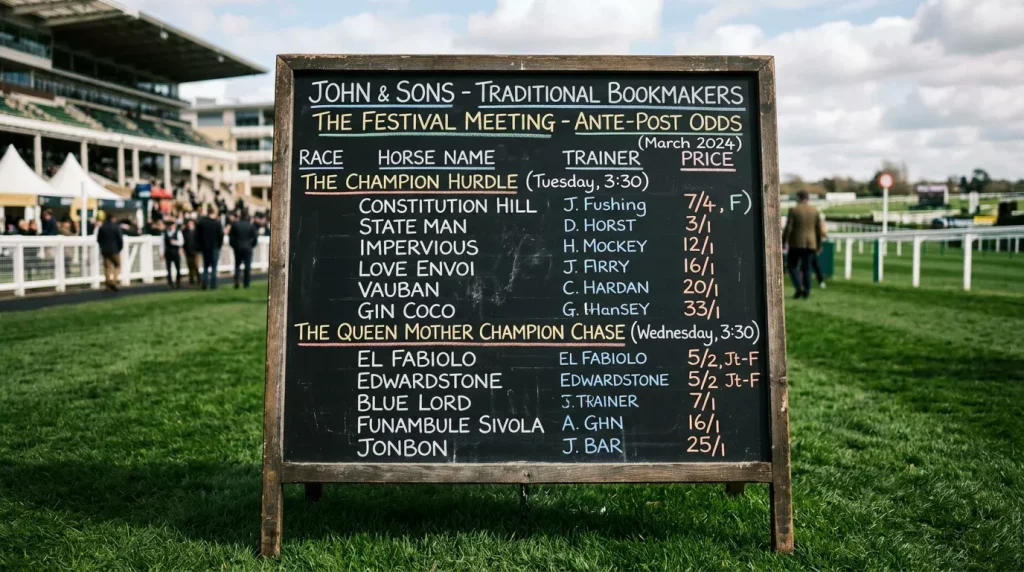
Early prices — the odds a bookmaker offers the morning of a race, sometimes even the night before — exist because the bookmaker wants to attract money and shape the market. These prices tend to be more generous than the final starting price (SP) because they carry more risk for the firm: the bookmaker is committing to a price before the full weight of market money has been absorbed. As more bets come in, popular horses shorten and unfancied horses drift. The SP is the price recorded at the moment the race starts, determined by the on-course market.
The strategic question is whether to lock in an early price or take SP. If you have done your homework and believe a horse is overpriced in the morning, taking the early price protects you against the market shortening. If you are less certain, or if you suspect the horse might drift, waiting gives you the chance to grab a bigger number later. There is no way to know in advance which approach wins on any given race. Over hundreds of bets, the punters who consistently take early prices on horses that subsequently shorten tend to come out ahead — because shortening prices are the market confirming that the horse was, in hindsight, underpriced.
The broader racing market has been contracting steadily. Betting turnover on British horse racing fell 4.3% in 2025 compared to 2024, extending a decline that has seen volumes drop over 10% from 2023 levels. In a shrinking pool, early prices can be more volatile — fewer large-staking punters means it takes less money to move a price. That volatility is an opportunity if you are watching the market carefully, and a trap if you are not.
Best Odds Guaranteed: Free Insurance Or Marketing Tool
Best Odds Guaranteed — BOG — is the promotion that eliminates the timing dilemma entirely, at least in theory. Take an early price, and if the SP is higher, the bookmaker pays out at the bigger number. You cannot lose by taking the price early, because the bookmaker covers any upward drift. It sounds too good to be true, and the natural question is: why would a bookmaker give that away?
The answer is volume. BOG encourages early betting, which lets the bookmaker shape its book with more time to balance liabilities. A firm that attracts morning money has hours to adjust other prices, hedge on exchanges, or lay off risk. The cost of occasionally paying out at SP when it is higher is offset by the trading advantage of knowing where the money is sitting before the race starts. For the bookmaker, BOG is not generosity — it is a data-gathering tool wrapped in a promotion.
For punters, BOG is genuinely useful — within limits. Most firms restrict it to UK and Irish races, often only on race-day morning prices, and sometimes cap the maximum payout uplift. A few exclude certain race types, particularly early-morning all-weather fixtures where the market is thin and price swings are larger. The first quarter of 2025 revealed another structural issue: turnover on core fixtures dropped 14.4% year-on-year while premier fixtures held steady. That divergence matters for BOG because larger-field premier meetings are exactly the races where early prices and SPs can differ significantly, making the guarantee most valuable.
I use BOG as a default whenever it is available. There is no downside. If the SP comes in lower than my early price, I keep the early price. If the SP goes higher, I get the upgrade. The only discipline required is checking whether the promotion actually applies to the specific race and the specific bet type before assuming it does.
Finding Value: When The Price Is Wrong
Every experienced punter I know eventually arrives at the same conclusion: the goal is not picking winners, it is finding prices that are wrong. A horse can win at 1/4 and still be a terrible bet if its true chance was closer to 1/6. Conversely, a horse that finishes fourth at 10/1 might have been an excellent bet if its real probability was 15% rather than the 9% implied by the price. Value is the gap between what the bookmaker thinks and what the race actually warrants.
This sounds abstract until you live it. I spent two seasons tracking every bet I made, recording my own probability estimate alongside the bookmaker’s implied probability. The exercise was humbling. In the first year, my estimates were barely more accurate than chance. By the second, patterns emerged — I was consistently better at pricing small-field National Hunt races than big-field handicaps, and consistently worse at anything on the all-weather. That self-knowledge was worth more than any tipster subscription.
The racing industry’s structural shift makes value-hunting both harder and more rewarding. Under-18 attendance at British racecourses surged 17% in 2025 to over 211,000 young visitors, signalling a new generation of recreational punters entering the market. More recreational money in the pool tends to create more pricing inefficiencies — because casual bettors overback favourites, overlook first-time handicap runners, and pile into horses they have seen on television. For anyone willing to do the work, those inefficiencies are where profit lives.
Finding value consistently requires three things: a method for estimating probability (even a rough one based on form, class, and going preferences), the discipline to bet only when your estimate exceeds the bookmaker’s implied probability by a meaningful margin, and a record-keeping system that tells you whether your method is working over hundreds of bets. Without the third element, you are guessing and calling it strategy.
Worked Examples: Three Bets From Scratch
Theory is useless without practice. Here are three bets, worked through from fraction to final return, covering the most common scenarios a UK punter encounters.
Example One: A Simple Win Bet
You fancy a horse at 7/2 and stake £10. The fraction tells you: seven pounds profit for every two pounds risked. Profit = (7 / 2) x £10 = £35. Total return = £35 + £10 stake = £45. In decimal terms, 7/2 converts to 4.50 (divide 7 by 2, add 1). Return = £10 x 4.50 = £45. Same answer, different route.
Example Two: An Odds-On Favourite
A horse is priced at 4/7 and you stake £14. The fraction: four pounds profit for every seven risked. Profit = (4 / 7) x £14 = £8. Total return = £8 + £14 = £22. The implied probability is 7 / (4 + 7) = 63.6%. You are betting on a horse the market considers a near two-in-three chance. Before placing this kind of bet, ask yourself: is this horse genuinely a 64% proposition, or is the short price just the market following the crowd?
Example Three: An Each-Way Bet
An each-way bet is two bets — one on the horse to win, one on it to place — so your total outlay is double the unit stake. You back a horse at 10/1 each-way for £5, meaning you are staking £10 total (£5 win, £5 place). If the horse wins, you collect the win bet at 10/1 (£50 profit + £5 stake = £55) plus the place bet at a fraction of the odds, typically 1/4 for non-handicap races with eight or more runners. The place payout: (10/1 x 1/4) = 10/4, or 5/2. Profit on place = (5/2) x £5 = £12.50 + £5 stake = £17.50. Total return if the horse wins: £55 + £17.50 = £72.50 from a £10 outlay. If the horse finishes second or third (but not first), you lose the win portion but collect £17.50 from the place bet — still a profit of £7.50 on your £10 total stake. The mechanics of each-way betting and when it represents genuine value depend heavily on field size and place terms, which shift the maths significantly.
Your Odds Questions, Answered Directly
These four questions come up in nearly every conversation I have with someone new to racing odds. They are worth addressing head-on because the answers sit at the intersection of maths and market reality.
The concept of “odds-on” confuses newcomers because it feels backwards — you are risking more than you stand to win. But the implied probability at odds-on is always above 50%, meaning the market believes the horse is more likely to win than lose. A price of 4/7 implies a 63.6% chance. Whether that probability is correct is a separate question, but the price itself simply reflects majority confidence. In practical terms, odds-on favourites win often enough to justify the small margins — the challenge is whether those small margins compound into profit over time, or whether the occasional loser wipes them out.
The bookmaker’s profit mechanism is the overround, not some hidden fee deducted from your payout. By pricing every horse slightly below its true probability, the bookmaker ensures that the total implied probability across the field exceeds 100%. In a market generating £766.7 million in gross gambling yield from remote horse racing betting alone, those small percentage edges compound into substantial revenue. The overround is not a conspiracy — it is a publicly visible number you can calculate yourself.
Whether the starting price beats the early board price depends entirely on the direction the market moves. If a horse shortens (its price gets smaller), taking the early board price was the right call. If a horse drifts (its price increases), the SP delivers better value. Over a season, my records show roughly 55% of early prices I take end up being better than SP — but that is skewed by the fact that I tend to back horses I expect to shorten. Without BOG, timing becomes a genuine strategic decision. With BOG active, the question disappears.
BOG restrictions on certain horses usually apply to early-morning fixtures, non-UK races, or horses below a minimum price threshold. The bookmaker limits BOG exposure where market liquidity is thin and price swings are unpredictable. If a horse opens at 20/1 on a Monday-morning all-weather card with three other runners, the bookmaker cannot afford to guarantee odds that might collapse to 6/1 by post time. Checking the terms takes thirty seconds and saves confusion when settling time arrives.
Articles

Published by the Furlongcraft team.
