
Lucky 15 To Goliath: The Full-Cover Bet Family Decoded
 Available in US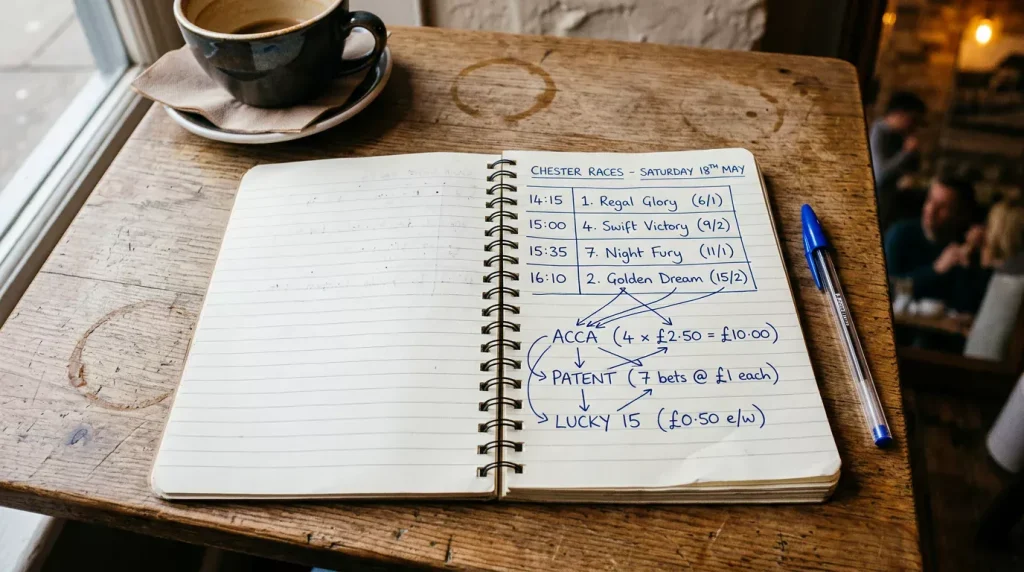
A Bet Slip That Needed A Calculator
The first time I filled out a Lucky 15, I was standing in a betting shop in Newbury, scribbling four selections on a paper slip and then staring at the grid trying to work out exactly how many bets I was placing. Fifteen, obviously – the name gives it away – but understanding what those fifteen bets actually were took longer than picking the horses. Full-cover bets sit in a strange corner of racing culture: everybody has heard of them, most people have placed one, and very few can explain what happens inside the slip once the races start.
This family of bets – Lucky 15, Lucky 31, Lucky 63, Yankee, Canadian, Heinz, Super Heinz and Goliath – all share the same logic. You choose a set of selections and the bet covers every possible combination of singles, doubles, trebles and higher multiples from that set. What changes is how many selections you start with and whether singles are included. The total number of bets escalates fast, and so does the cost.
Lucky 15 To Goliath — More on this topic at horse racing betting how to .
The Full-Cover Family Tree
Full-cover bets split into two branches. The “Lucky” branch includes singles; the “named” branch does not. That distinction matters more than most punters realise, because singles are the bets most likely to return something.
With four selections, a Yankee gives you 11 bets: 6 doubles, 4 trebles, 1 four-fold. A Lucky 15 adds the 4 singles, totalling 15 bets. With five selections, a Canadian (also called a Super Yankee) gives you 26 bets without singles; a Lucky 31 adds the 5 singles. With six, a Heinz is 57 bets without singles; a Lucky 63 adds 6 singles for 63 bets total. And the Goliath covers eight selections across 247 bets – no singles included.
The naming is eccentric. “Heinz” comes from the 57 varieties slogan. “Goliath” is self-explanatory once you see the stake requirement. A £1 Goliath costs £247. A £1 Lucky 63 costs £63. These are not casual bets; they are structured investments into probability, and the structure deserves scrutiny.
UK horse racing generates £766.7 million in gross gambling yield from remote betting alone. A meaningful slice of that flows through full-cover bets, particularly at festivals where punters have multiple fancies across a card.
Lucky 15, Lucky 31 And Lucky 63
I have a soft spot for the Lucky 15, and I will explain why: it is the only full-cover bet where one winner can still produce a meaningful return relative to your outlay. Most bookmakers offer a consolation bonus on Lucky 15s – typically double the odds on your single if only one selection wins, and a percentage bonus if all four land. That consolation turns the Lucky 15 from a pure gamble into something with a floor.
Say you pick four horses. One wins at 5/1. On a straight single at £1, you collect £6. On a Lucky 15 at £1 per line, you have spent £15 and your one winner returns £12 (doubled odds on the single). You are still down £3, but you have not been wiped out. If two of the four win, you collect two singles plus a double, and depending on the prices, you can break even or profit from a 50% strike rate. That is the safety net the Lucky bets provide, and it is absent from the Yankee, Canadian and Heinz.
The Lucky 31 and Lucky 63 extend the same logic to five and six selections. The cost rises sharply – £31 and £63 per unit stake – and the consolation bonus matters less because your total outlay is higher. A Lucky 63 at £1 per line needs at least two winners at decent prices to avoid a painful loss. The more selections you add, the closer the Lucky family gets to a pure accumulator in terms of risk, even though the structure suggests otherwise.
Overall online betting turnover on British racing dropped by 16.3% over three years to £8.73 billion, a contraction that has squeezed bookmaker margins and made them more reliant on recreational multi-bet products – full-cover bets very much included.
Yankee And Canadian
A Cheltenham Tuesday taught me the difference between a Lucky 15 and a Yankee the hard way. I placed a Yankee – 11 bets, no singles – on four horses across the afternoon card. Two won at short prices. The doubles returned a small profit, but I had spent £11 per unit and the two singles that would have padded the return did not exist. I walked away roughly level when a Lucky 15 would have put me ahead.
The Yankee is a four-selection bet covering 6 doubles, 4 trebles and a four-fold. No singles. You need at least two winners to see any money back, and those two winners need to be at combined odds that overcome your 11-unit outlay. At short prices – say 2/1 and 5/2 – two winners from four on a Yankee barely cover the stake. The bet only starts to breathe when prices are longer or when three or four selections land.
The Canadian, or Super Yankee, extends this to five selections: 10 doubles, 10 trebles, 5 four-folds and a five-fold – 26 bets in total. The maths is the same but the cost is higher and the probability of landing enough legs to profit is lower. Canadians appeal at big meetings where a punter has five strong opinions across a card, but “five strong opinions” is a phrase that should trigger caution, not confidence.
See also Ante-Post Betting Explained .
Heinz, Super Heinz And Goliath
Beyond the Canadian, the numbers become genuinely intimidating. A Heinz covers six selections in 57 bets. A Super Heinz covers seven in 120 bets. A Goliath covers eight in 247 bets. At £1 per line, a Goliath costs £247 – more than most punters allocate to a full month of betting.
I have placed exactly one Heinz in six years. Six selections, £0.50 per line, total outlay £28.50. Three winners, two at decent prices. The return was just under £40. I made a profit of roughly £11 on a bet that took the entire afternoon to resolve and required a spreadsheet to verify. The experience was educational but not repeatable. The Heinz needs at least three winners at reasonable prices to clear the 57-unit stake, and three from six is a strike rate most punters cannot sustain.
The Goliath is, for practical purposes, a novelty bet. At 247 lines you are paying for every conceivable combination of eight selections, and the probability of enough legs landing at sufficient prices to justify that cost is vanishingly small. Bookmakers are happy to accept Goliaths because the compounded margin across 247 bets is enormous. If you feel compelled to place one, treat it as entertainment with a hard spend limit – and know that the bookmaker is smiling when they process the slip.
How Bonuses Are Calculated
Full-cover bonuses vary by bookmaker but follow a common pattern. On a Lucky 15, the standard offer is double the odds on one winner and a 10% bonus on total returns if all four win. On a Heinz, the all-winners bonus might be 25%. On a Goliath, some bookmakers offer 100% – doubling your total return if all eight selections come in.
These bonuses sound lavish until you consider the probability of triggering them. All four winners in a Lucky 15, assuming each selection has a 25% chance, occurs roughly once in every 256 attempts. All eight in a Goliath? Once in about 65,000 attempts at the same strike rate. The bonus exists because it almost never fires, and when it does, the publicity value to the bookmaker exceeds the cost.
The consolation bonus – doubled odds on a single winner – is the only part of the structure with genuine practical value, and it applies only to the Lucky variants. If you are considering a full-cover bet, the consolation is the strongest argument for choosing a Lucky 15 over a Yankee at the same number of selections. It will not make you profitable long-term, but it reduces the frequency of total wipeouts, which is worth something for your accumulator and multi-bet strategy.
Articles
Created by the "Furlongcraft" editorial team.
