
Responsible Gambling Tools In The UK: Beyond The Footer Disclaimer
 Available in US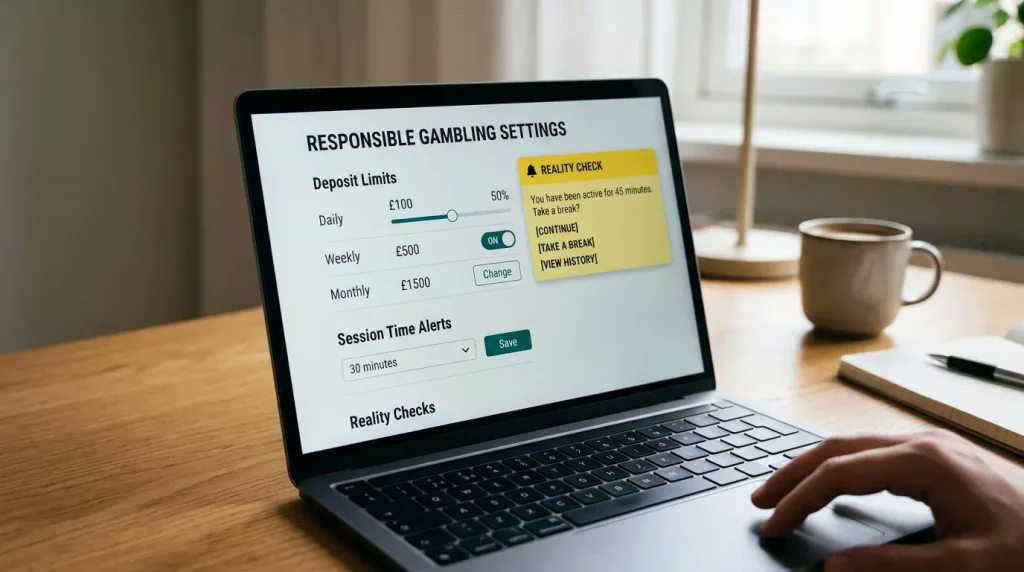
The Tools Nobody Reads About Until They Need Them
I set my first deposit limit three years into my betting life. Not because I had a problem – I didn’t, not yet – but because I’d just had a month where I’d deposited far more than I’d planned. The racing had been good, the results hadn’t, and the app made it so effortless to add another £20 that I’d done it seven times before I checked the statement. The deposit limit I set that evening was £200 a month. I’ve adjusted it twice since then, once up and once down. Both times I had to wait 24 hours for the increase to take effect, which is exactly the kind of friction that turns an impulse into a decision.
Responsible gambling tools exist on every UKGC-licensed platform. They’re real, they work, and most punters ignore them until something goes wrong. The problem isn’t availability – it’s visibility. These tools are typically buried in settings menus, described in regulatory language, and presented as obligations rather than advantages. That’s a design failure, because for anyone who bets regularly, these tools are as essential as a form guide.
Responsible Gambling Tools In The UK — More on this topic at horse racing betting how to .
The Tool Stack
The responsible gambling toolkit available to UK punters covers five main areas: deposit limits, loss limits, time-outs, reality checks, and self-exclusion. Each operates independently, and they can be combined. A punter can set a weekly deposit limit, enable a 60-minute session reminder, and still have the option to take a 24-hour time-out if a session feels like it’s going sideways.
About 13% of the UK population visits a betting shop at least once a month, and every one of those shops carries the same regulatory responsibility to offer and promote responsible gambling tools. But the implementation differs enormously between the high-street shop and the app. In-shop, the tools are less granular – you can self-exclude, but setting a precise deposit limit for your cash transactions is harder to enforce. Online, the tools are programmable and automatic, which makes them more powerful but also easier to overlook because they operate silently in the background.
22.5 million UK adults bet at least once a month. The vast majority do so without harm. But the tools aren’t only for the small percentage who develop problems – they’re preventive measures that help the majority stay in control. A deposit limit doesn’t mean you have a gambling problem any more than a seatbelt means you expect a crash. It means you’re managing risk sensibly.
GAMSTOP Explained
GAMSTOP is the UK’s national self-exclusion scheme for online gambling. When you register with GAMSTOP, you’re excluded from all UKGC-licensed online gambling operators for a minimum period of your choosing: six months, one year, or five years. The exclusion covers all online gambling – not just horse racing, but casino, poker, slots, and sports betting across every licensed site and app.
The scheme works through a central database. When you register, your details are checked against operator records, and your accounts are blocked across the board. The block is comprehensive but not instantaneous – operators are required to apply the exclusion within 24 hours. Once active, you cannot log in, place bets, or access your accounts until the exclusion period ends.
GAMSTOP is a serious step. It’s designed for people who need a complete break from online gambling, not for those who want to take a week off. The minimum six-month duration reflects that intent. If you want a shorter break, individual operator time-outs are more appropriate – most platforms offer 24-hour, 48-hour, one-week, and one-month options.
One common misconception is that GAMSTOP covers everything. It doesn’t. It applies only to online operators licensed by the UKGC. It does not cover betting shops, on-course bookmakers, the Tote at racecourses, or – critically – unlicensed offshore operators. For those who need exclusion from high-street shops, a separate scheme called the Multi-Operator Self-Exclusion Scheme (MOSES) covers physical betting premises.
Deposit And Loss Limits
Deposit limits cap the total amount you can transfer into your betting account over a set period – daily, weekly, or monthly. Loss limits cap the amount you can lose. The distinction matters: a deposit limit prevents you from putting more money in, but doesn’t restrict what you do with funds already in your account. A loss limit stops you losing beyond a threshold, even if your balance is higher.
Setting these limits is straightforward on any UKGC-licensed app. The critical design feature is the asymmetry: decreases take effect immediately, but increases require a cooling-off period (usually 24 hours). This asymmetry is deliberate and effective. It means you can protect yourself on impulse, but you can’t remove that protection on impulse. The 24-hour wait isn’t a bug – it’s the entire point.
My practical suggestion is to set a monthly deposit limit based on what you’d genuinely be comfortable losing in a bad month. Not your best month, not your expected month – your worst-case month. If that number makes you uncomfortable, it’s too high. Adjust until the limit feels like a number you’d forget about rather than bump up against. That’s the sweet spot.
Reality Checks And Time-Outs
Reality checks are periodic notifications that remind you how long you’ve been in a session and how much you’ve staked or lost. Some operators make these mandatory at intervals (every 60 minutes is common); others let you set your own frequency. The notifications pop up during active use and require acknowledgment before you can continue.
These work better than you’d expect. The first few times, you dismiss the notification reflexively. But the third or fourth time it appears, especially if the session has gone badly, it forces a moment of self-assessment. “You’ve been playing for 3 hours and deposited £80” hits differently at 11pm on a Tuesday than it does in the abstract. That moment of forced awareness is the tool doing its job.
Time-outs are voluntary breaks from a single operator. A 24-hour time-out locks you out of the platform for a day. A one-week time-out does the same for seven days. Unlike GAMSTOP, time-outs are operator-specific – you’re only locked out of the platform where you set the time-out, not across the entire licensed market. This makes them more flexible but less comprehensive. If you find yourself setting a time-out on one app and immediately opening another, the time-out isn’t doing enough and GAMSTOP may be more appropriate.
See also Unlicensed Bookmakers In The UK .
Single Customer View
The single customer view is a regulatory concept that’s becoming operational reality. The idea is that each licensed operator should hold a comprehensive picture of each customer’s gambling activity: deposits, withdrawals, losses, session frequency, payment method changes, and behavioural patterns. This data allows the operator to identify signs of harm – escalating deposits, chasing losses, extended sessions – and intervene proactively.
In practice, the single customer view is still limited to individual operators. No centralised cross-operator database yet exists that would allow, say, three different bookmakers to see that you’ve deposited £200 across their collective platforms in a single day. The Gambling Commission has discussed cross-operator data sharing, and it may come, but as of 2026 each operator works from its own data.
For punters, the practical implication is that self-management is still essential. The operator’s single customer view helps them flag potential issues, but it can’t see what you’re doing on other platforms. Keeping your own records – deposits, losses, time spent – remains the most reliable way to monitor your gambling behaviour. Responsible tools are powerful, but they work best when the punter is already paying attention.
Articles


Published by the Furlongcraft team.
