
Placepot Strategy: How To Build A Realistic Ticket Across Six Races
 Available in US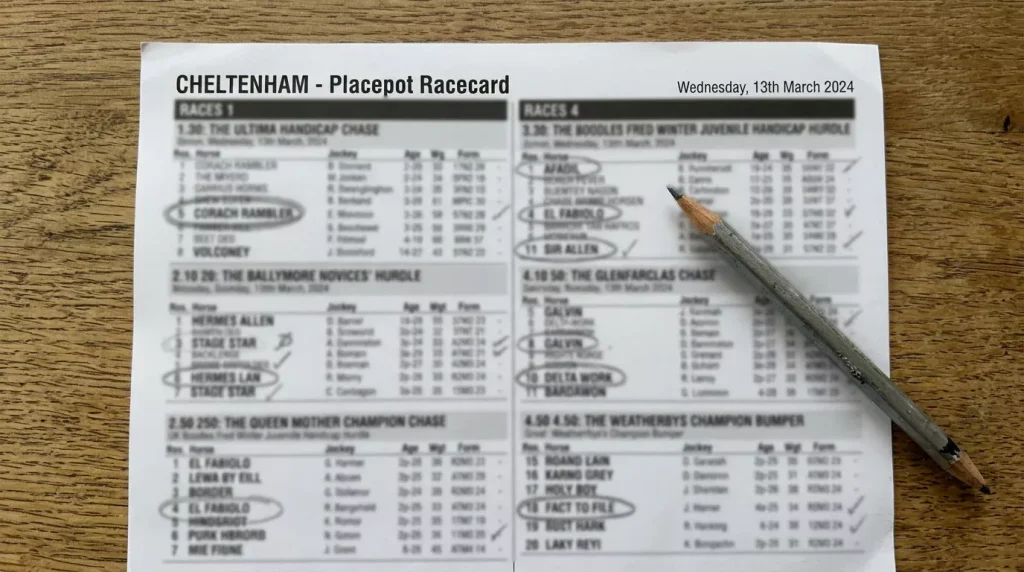
A £2 Ticket That Paid £312
The best return I have ever had from a £2 outlay was a Placepot at a midweek Wetherby meeting. Nothing glamorous – Class 4 handicaps and a novice chase – but the favourite fell in race three and the dividend exploded. That £312 came from a game that most punters walk past on their way to the fixed-odds windows, and it arrived because I understood one thing: the Placepot is not a bet on winners, it is a bet on survival.
The Placepot is a Tote pool bet requiring you to find a placed horse in each of the first six races at a meeting. It is the oldest and most popular of the Tote’s combination products, and the pool turnover across all Placepots feeds into the UK Tote’s overall annual handle of approximately £78.2 million. The dividends vary wildly – from a few pounds on days when the favourites all oblige, to four-figure returns when results go against the market.
Placepot Strategy — More on this topic at horse racing betting how to .
How The Placepot Works
You make one or more selections in each of the first six races at a meeting. If at least one of your selections places in every race, you hold a winning ticket. “Places” follow the same terms as each-way betting: first two in fields of five to seven runners, first three in fields of eight or more, first four in handicaps of sixteen or more.
The minimum unit stake is 50p per combination. If you pick one horse in each of the six races, you have one combination, costing 50p. If you pick two horses in one race and one in each of the others, you have two combinations, costing £1. The number of combinations – and therefore the cost – multiplies rapidly as you add selections, which is where perming comes in.
The pool works like any other Tote product: all stakes go in, the Tote takes its deduction, and the remainder is shared among winning tickets. The fewer winning tickets, the bigger the dividend. This is why disrupted meetings – where favourites fall, get beat, or are withdrawn – produce the best Placepot returns.
Perming Explained
A perm is a structured way of covering multiple selections without having to back every possible combination individually. In Placepot terms, perming means choosing more than one horse in selected races to increase your chances of surviving each leg.
The maths is multiplication. If you pick 2 horses in race one, 1 in race two, 3 in race three, 1 in race four, 2 in race five, and 1 in race six, your total combinations are 2 x 1 x 3 x 1 x 2 x 1 = 12. At 50p per combination, your ticket costs £6. That is a manageable outlay for a six-race investment with a genuine shot at a meaningful return.
The skill is deciding where to perm and where to bank. Perming every race is expensive and defeats the purpose of the Placepot as a low-cost bet. Perming none of them is risky – you need to find six consecutive placed horses from six single selections, which even in favourable conditions is a tall order. The strategy lives in the middle: bank the races where you have a strong opinion, perm the races where the outcome is open.
Banker Selections
A banker is a single selection in a race – you are committing to that one horse as your Placepot representative. If it fails to place, your entire ticket is dead. The advantage of banking is cost: one selection in a race keeps the combinations down. The risk is obvious.
I bank in two situations. First, when a race has a standout horse whose placing chances are genuinely high – not just the favourite, but one I consider near-certain to finish in the frame. A 1/3 shot in a small field with no credible danger is a reasonable bank. Second, when I have a strong form opinion that disagrees with the market and I am happy to live or die by that view. Banking a 5/1 shot feels uncomfortable, but if your analysis says it places, the cost saving from one selection versus three is significant.
The mistake I see most often is banking the favourite in every race. Favourites place at a high rate, but not at 100%, and a six-race ticket with six favourite bankers will fail surprisingly often. One stumble in race three and the whole ticket is dead. The Placepot rewards intelligent coverage, not blind faith in the market leader.
See also Rule 4 Deductions .
Staking The Perm
Budget is the anchor. I decide my total Placepot spend before I look at the card, and then I work backwards to a perm structure that fits. If my budget is £10 and my perm produces 20 combinations, I go at 50p per line. If the perm produces 8 combinations, I can afford £1.25 per line. The key is that the total outlay is fixed and the perm structure flexes around it.
There is a temptation – especially on festival days with big pools – to scale up the perm to cover more outcomes. Resist it. A 48-line Placepot at 50p costs £24, and the dividend might be £6. The cost of coverage eats your profit. Festival Placepots attract huge pools, which means more winning tickets, which means lower dividends. Over 5 million people attended British racecourses in 2025, and on big days the Placepot pool is diluted accordingly.
The strongest Placepot returns come from situations where your perm is modest, the meeting is mid-tier, and a couple of results go against the crowd. That combination – low cost, thin competition, volatile results – is the Tote pool environment at its best.
Big Meetings Vs Midweek Cards
Cheltenham Festival Placepots regularly build pools exceeding £1 million. The dividend can still be large if results are chaotic, but the sheer number of winning tickets in a pool of that size compresses returns. A £4 Placepot on Gold Cup day might return £80 – healthy, but not transformative. The same £4 at a Tuesday meeting at Catterick might return £800, because the pool was a fraction of the size and the dividend denominator was tiny.
I play Placepots more actively at midweek meetings for exactly this reason. The pools are smaller, the public attention is lower, and the dividends are more volatile. A single upset – one favourite who trails in fourth in a four-place race – can send the dividend spiralling upward because so many tickets in a thin pool were relying on that favourite.
At major meetings, I still play Placepots, but I adjust my expectations. The entertainment value is high – following six consecutive races with a ticket running is engaging regardless of the return – but the financial edge is thinner. If you are playing Placepots for profit rather than fun, the midweek cards are where the maths works hardest for you.
The same principle that makes Placepots rewarding – small pools with volatile dividends – also makes them unpredictable. You can build the perfect ticket, navigate five legs, and then watch your banker in race six get beaten a nose. That is the game. The process is sound; the outcome is not guaranteed. Treat it as a structured investment in probability, not a path to consistent income, and the Placepot earns its place in any serious punter’s toolkit.
Articles


Created by the "Furlongcraft" editorial team.
