
The UK Horse Racing Class System: From Class 7 To Group 1
 Available in US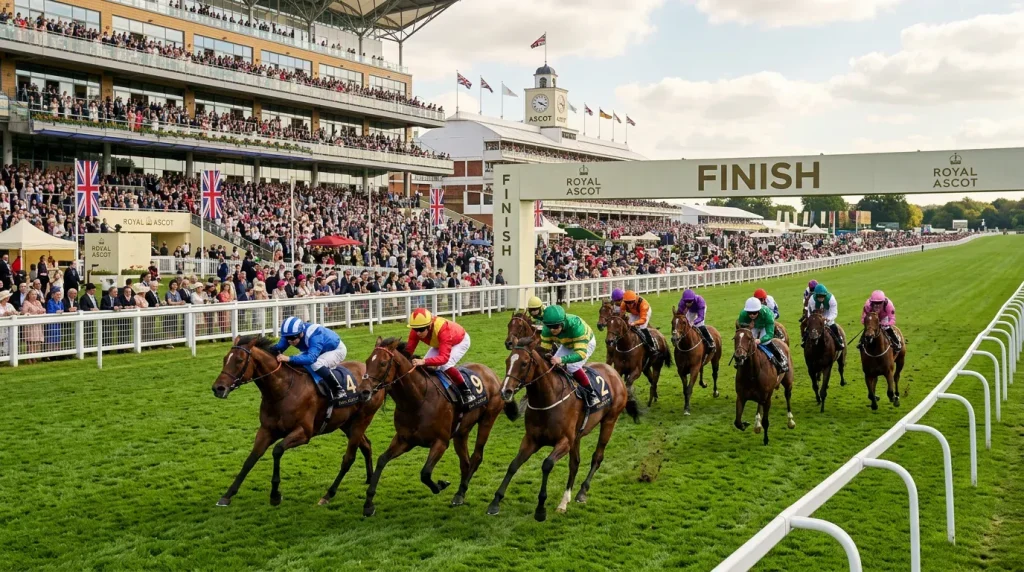
Why Class Is The First Filter, Not The Last
Early in my betting life I backed a horse in a Class 2 handicap at Newbury because he’d won his last two starts impressively. What I hadn’t noticed was that both those wins came in Class 5 races at minor tracks. He’d been raised 18lb by the handicapper and thrown in three grades higher. He ran as if the ground had turned to treacle – beaten 14 lengths, never competitive. That was my introduction to why the class system exists and what it actually means for the betting market.
The BHA organises all races in Britain into seven numbered classes, with Class 1 at the top and Class 7 at the bottom. Class isn’t just prestige – it’s a direct measure of the ability level a horse must reach to be competitive. Every step up the ladder narrows the margin between horses and raises the price of mistakes, both for trainers and punters.
The UK Horse Racing Class System — More on this topic at horse racing betting how to .
Class 1: The Elite
Class 1 contains everything from Group 1 contests – the Champions Stakes, the 2000 Guineas, the Gold Cup – down to Listed races and high-end handicaps. Prize money at this level hit record territory in 2025, with total purses across British racing reaching £194.7 million. The elite races draw the best horses, the best jockeys, and the most liquid betting markets.
For punters, Class 1 races are a paradox. The form is the most reliable because the horses are proven. But the prices reflect that reliability – finding value is harder because the market is efficient. Bookmakers deploy their sharpest traders on Group races, and the exchanges attract the heaviest volume. The edge in Class 1 rarely comes from spotting a good horse. It comes from reading the race conditions: the going, the likely pace, the draw – factors the market can underweight because it’s focused on ability.
Group races are subdivided into Group 1, Group 2, and Group 3, with Group 1 carrying the highest rating threshold and the richest prize money. Listed races sit just below Group 3 but still carry Pattern status. A horse who has competed at Listed level and drops into Class 2 is a fundamentally different proposition from one rising from Class 3, even if their official ratings are similar. Pattern experience counts because the tempo, the competitiveness, and the pressure of top-class racing are hard to replicate lower down.
Classes 2 To 4: The Competitive Middle
This is where most serious punters spend their time, and for good reason. Class 2 handicaps often feature horses rated 85-105 – good enough to compete but not so highly rated that every performance is analysed in granular detail by the market. Class 3 is the broadest band, accommodating horses rated roughly 70-90, and Class 4 typically runs from 55 to 75.
The middle classes are where class drops produce the best betting angles. A horse rated 88 who has been running in Class 2 company without threatening drops to a Class 3 where its rating towers over the field. The question is always why. Sometimes the trainer is looking for an easier opportunity before a bigger target. Sometimes the horse is regressing and the rating hasn’t caught up. Distinguishing between the two is the daily work of form reading.
The middle grades also produce the most competitive handicaps, which is where field sizes matter. Average runners per race on the Flat dropped to 8.9 in 2025, and those smaller fields disproportionately affect Class 3 and 4 contests. Fewer runners mean fewer opportunities for closers to find cover and for pace to collapse – dynamics that reshape how you approach each race.
If you’re reading a racecard for the first time, the class of the race is printed alongside the race title and conditions. It’s the single most important piece of context before you look at any individual horse.
Classes 5 To 7: Where Opportunity Hides
I know punters who refuse to bet below Class 4. Their argument is that the form is unreliable, the horses are inconsistent, and the races are too unpredictable. They’re not entirely wrong – but they’re missing some of the easiest money in racing.
Class 5, 6, and 7 races are dominated by horses with lower official ratings, younger or less experienced runners, and trainers campaigning at the lower end of the spectrum. The form is more volatile because these horses haven’t established their level. But volatility is exactly what creates value. When a field of Class 6 maidens goes to post and the market sends one horse off at 6/4, the question isn’t whether that horse will win – it probably will – but whether 6/4 adequately reflects its true chance. In a 12-runner Class 6 with several unexposed types, the answer is often no.
The sharpest angle at the lower classes is the well-bred horse from a top yard running in modest company. These horses are often being given experience before stepping up, and their connections know far more about their ability than the bare form suggests. When a trainer like William Haggas or Charlie Appleby runs a horse in a Class 5, pay attention. The class of the race may be low, but the intent behind the entry rarely is.
See also Handicap Racing Explained .
Class And Betting Strategy
The BHA’s own modelling projects a 6-7% decline in runs across British racecourses between 2024 and 2027. That contraction won’t be evenly distributed – lower-class races are the most vulnerable, because they depend on larger horse populations and weaker prize money to justify their existence. For punters, this means the landscape is shifting. Fewer races means fewer opportunities, and the races that survive will be more competitive within their class band.
My approach to class is straightforward. I separate my analysis into two stages: first, does the horse belong in this class? Second, does it have the specific profile to win this particular race? The first question filters out the obvious mismatches – the horse dropping from Class 2 because it can’t compete there, or the Class 6 regular entered optimistically in a Class 4. The second question is where the real handicapping happens: ground, trip, pace, jockey, draw.
Class isn’t a guarantee of anything. I’ve seen Class 1 winners finish tailed off in Class 3 handicaps, and Class 6 graduates win listed races within a year. What class gives you is a framework for expectation – a starting point for how good a horse needs to be to compete. Build your selections from that foundation, and you’ll find the betting falls into place more often than it doesn’t.
Articles



Published by the Furlongcraft team.
