
Gambling Tax In The UK: What The Punter Pays And What Sits On The Bookmaker
 Available in US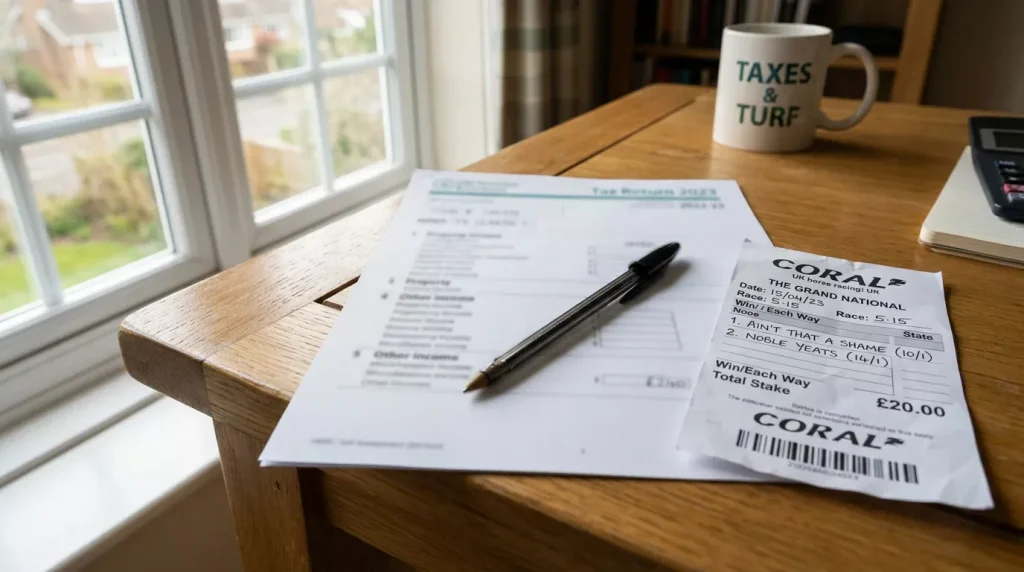
I once sat next to a bloke at Cheltenham who told me, with absolute certainty, that HMRC takes 9% of every winning bet. He had been deducting that amount from his records for three years. His spreadsheet was meticulous – and completely wrong. Tax on gambling in the UK is one of those subjects where everyone has an opinion and almost nobody has the right one. The short version is this: you, the punter, pay nothing on your winnings. The longer version involves three different duties, a budget that rattled the entire industry, and a carve-out for horse racing that might just save your betting margins.
Gambling Tax In The UK — More on this topic at horse racing betting how to .
Why Your Winnings Are Not Taxed
Before October 2001 punters paid a 9% betting duty on every stake – or, if they preferred, on their returns. The industry lobbied hard, arguing that the tax was driving bettors to offshore operators who did not charge it. Gordon Brown’s government agreed and shifted the burden entirely onto the bookmaker through a gross profits tax. The logic was straightforward: tax the business, not the customer, and keep the money onshore.
That principle has held ever since. HMRC treats gambling winnings as the product of chance rather than income. There is no capital gains event, no self-assessment box, no threshold above which your winnings become taxable. A £50 return on a Saturday accumulator and a £50,000 payout on an ante-post bet at Royal Ascot receive identical tax treatment from the Revenue – which is to say, none at all. Your winnings land in your account whole, and they stay that way.
The Duty That Sits On The Bookmaker
What punters do not see is the machinery behind the screen. Bookmakers operating in the UK face three overlapping duties depending on the type of gambling they offer. General Betting Duty applies to fixed-odds sports betting, currently set at 15% of gross gambling yield for horse racing. Remote Gaming Duty covers online casino products – slots, table games, live dealer – and sits at 21% until April 2026. Pool Betting Duty, relevant to the Tote and football pools, is a separate calculation again.
These duties are levied on gross gambling yield, or GGY – the difference between stakes received and winnings paid out. If a bookmaker takes £1 million in stakes on a Saturday and pays back £920,000, the GGY is £80,000 and the duty is calculated on that figure. This is why bookmakers care so deeply about overround and margin management. Every percentage point of margin they lose to competitive pricing or promotional offers is a percentage point of GGY that still attracts duty.
The point-of-consumption model, introduced in 2014, means any operator offering bets to UK customers pays the duty regardless of where the company is based. A Gibraltar-headquartered bookmaker and a London-headquartered one face identical rates. That closed the offshore loophole for licensed operators, though it obviously has no grip on unlicensed sites operating outside UK regulation entirely.
The Autumn Budget 2025 And What Changed
The Autumn Budget of November 2025 landed like a grenade in the betting industry. Remote Gaming Duty – the rate on online casino products – will nearly double from 21% to 40% starting April 2026. General Betting Duty on online sports betting other than horse racing rises from 15% to 25% from April 2027. Horse racing betting duty stays at 15%, a deliberate carve-out that the government justified on cultural and economic grounds.
Grainne Hurst, the Betting and Gaming Council’s Chief Executive, called the rises a “devastating hammer blow” to the industry and its workforce. That was not hyperbole for the cameras. EY modelling commissioned by the BGC estimated the Remote Gaming Duty hike alone could cost around 15,000 high-tech jobs and shift £4 billion in stakes to unlicensed operators. Raise the sports betting duty and another £2 billion moves offshore, with a further 1,750 jobs at risk – roughly 17,000 positions in total.
For horse racing punters, the 15% carve-out is the headline that matters. The government recognised that racing’s funding model – the Horserace Betting Levy – depends on betting turnover, and taxing racing bets at the higher rate could choke the sport’s revenue stream. Whether that protection survives future budgets is an open question, but for now it means that the bookmaker’s tax burden on your racing bet is materially lower than on a football or tennis bet. In theory, that should translate into slightly better margins and pricing for racing customers. In practice, it depends on whether operators pass the saving through or absorb it.
See also The Horserace Betting Levy .
The Professional Gambler Question
Every few months someone asks me whether full-time, profitable betting crosses the line into taxable income. The short answer remains no – but the reasoning matters. HMRC’s position, tested in case law going back to Graham v Green in 1925, is that gambling winnings are not “income” because they do not arise from an employment, a trade, or an investment. The fact that a person is skilled, consistent, and profitable does not convert their winnings into trading profits.
There is a theoretical edge case. If HMRC could demonstrate that a person was providing a service – selling tips, managing a syndicate’s money, operating as a de facto fund manager – the income from that activity might be taxable. But the winnings themselves, derived from placing bets on your own account with your own money, remain outside the tax net. No court has overturned that principle in a century of challenges, and HMRC has not shown appetite to test it again. That said, this is tax guidance, not tax advice. Anyone whose betting generates six-figure annual returns should have a conversation with an accountant, if only to document the position clearly.
Betting Abroad And Cross-Border Tax
If you place a bet with a licensed UK-facing operator while on holiday in Spain, nothing changes. The duty is on the operator, not on you, and it is determined by where the customer is based, not where the bet is placed. Your winnings remain tax-free in the UK.
Complications arise only if you open an account with a local operator in a country that taxes gambling winnings – parts of the United States, for example, or Denmark. In that scenario the foreign jurisdiction may withhold tax at source, and whether you can reclaim it depends on the specific double-taxation treaty. For the vast majority of UK punters betting on UK racing through UK-licensed bookmakers, the question is academic. Your tax position is zero, whether you place the bet from your sofa in Leeds or a poolside lounger in Malaga.
Articles




Written by the editors at Furlongcraft.
